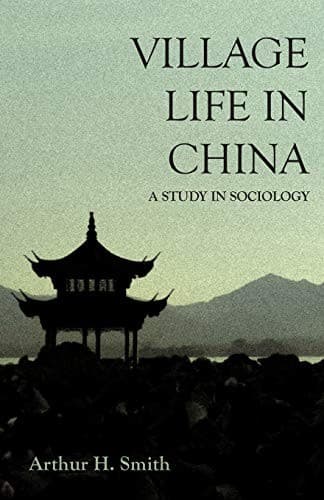
Village Life in China: A Study in SociologySmith, Arthur H.
General
Village Life in China: A Study in Sociology
Smith, Arthur H.
China -- Social life and customs; Villages
By the time a married woman had reached middle life her interest in her
original home may have greatly weakened. There are now young marriageable
girls of her own growing up, each of whom in turn repeats the experience
of her mother. To their fathers and also to their brothers these girls are
at once a problem and a menace. Could the birth-rate of girls be
determined by ballot of all the males of full age, it is probable that in
a few generations the Chinese race would become extinct. The expression
"commodity-on-which-money-has-been-lost," is a common periphrasis for a
girl. They no sooner learn a little sewing, cooking, etc., than they are
exported, and it is proverbial that water spilled on the ground is a
synonym for a daughter. "Darnel will not do for the grain-tax, and
daughters will never support their mothers." These modes of speech
represent modes of thought, and the prevailing thought, although happily
not the only thought of the Chinese people.
Girls as a rule have next to no opportunities for cultivating friendships
with one another. The readiness with which under favourable condition such
attachments are formed and perpetuated, shows how great a loss is their
persistent absence. When it is considered that each Chinese family
consists not of a man and his wife and their children, but of married
sons, and of their several wives, each one introduced into the circle in
the same compulsory way, each with a strong and an uncurbed will, yet
powerless to assert herself except by harsh speeches and bad temper, it is
evident that the result is not likely to be unity.
In the eye of Chinese law brothers are equal, and though the elder has
some advantages, a portion larger than that of the others is not one of
them. Sometimes the young married pair are given an outfit, say of cotton,
for spinning and weaving, and are thenceforth expected to support
themselves by this capital and their own added labour. Not infrequently an
unequal distribution of the land is made among several brothers by the
father while living, a wrong for which there is no remedy other than
remonstrance. Neither if the father should conceive the idea of depriving
a son of any portion at all in the land, is there effective redress.
Should the property be held in common according to Chinese traditions, it
is a physical, a psychological, and a moral impossibility that there
should not be ceaseless friction among so many claimants for what is often
at best a most inadequate support.
Public-domain text, read in full here on John Shaqi.
Reviews
Reviews
No reviews yet
Be the first to share your thoughts on this work.
Elsewhere in the archive
Join the Discussion
Join the discussion
Sign in to leave a comment or review.
Sign InorCreate an account