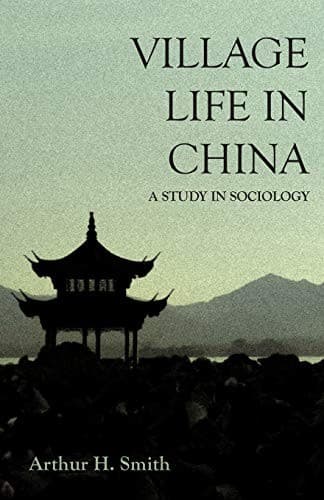
Village Life in China: A Study in SociologySmith, Arthur H.
General
Village Life in China: A Study in Sociology
Smith, Arthur H.
China -- Social life and customs; Villages
It is the Chinese theory that parents are to be taken care of in old age
by their children either in combination or in rotation. But cases in which
aged mothers have a portion to themselves, doing all their own cooking and
most of the other necessary work are everywhere numerous. A Westerner is
constantly struck with the undoubted fact that the mere act of dividing a
property seems to extinguish all sense of responsibility whatever for the
nearest of kin. It is often replied when we ask why a Chinese does not
help his son or his brother who has a large family and nothing in the
house to eat, "We have _divided_ some time ago." The real explanation is
perhaps to be found in the accumulated exasperations of the larger part of
a lifetime, once delivered from which, a Chinese feels that he can
judiciously expend his energies in looking out for Number One, leaving
the rest of the series to do the same as best they may.
If a member of a family is absent when a division is made, it is common to
hear that advantage has been taken of that fact to assign to him a portion
which he would not have quietly accepted had he been present. This is
particularly the case with the family debts, often aggregating a large
sum. Sometimes a young man is forced to begin life weighted down with
several hundred thousand cash worth of these liabilities due to some
unprofitable partnership of his father with his uncles--which may have
extended over a period of perhaps many years.
Another most undesirable but unavoidable asset is "empty grain-tax land!"
This means a liability to pay the tax on land which is non-existent, but
which has been made to appear to exist by mismeasurements in former years,
either by accident or design. Suppose, for example, that a family has a
hundred acres of land, which has to be sold in small pieces from time to
time as occasion arises. Each surveying party works from such indefinite
boundaries as the stump of an aged mulberry bush to another stump which
may prove to be missing. The one who buys the land will use his best
efforts to see that he gets good measure, which it is no concern of the
measurers to refuse. No one knows exactly what is left until some final
measurement becomes necessary, when it often appears that there is a
shortage of a considerable amount. From deficits like this there arises
the necessity of paying "empty taxes," and though the tax itself is
sufficiently solid and substantial, there is no way known to Chinese
practice by which such injustice can be rectified. The son who finds
himself saddled with this sort of a burden is not likely to contribute to
the harmony of the household in future, and were he ever so much inclined
to bury the matter in oblivion and "eat a dumb man's loss," his wife would
never stop talking about it, unless she chanced to be dumb herself. A
complete catalogue of the possible and indeed inevitable occasions which
produce family alienations and bitterness would of itself fill a volume,
Public-domain text, read in full here on John Shaqi.
Reviews
Reviews
No reviews yet
Be the first to share your thoughts on this work.
Elsewhere in the archive
Join the Discussion
Join the discussion
Sign in to leave a comment or review.
Sign InorCreate an account