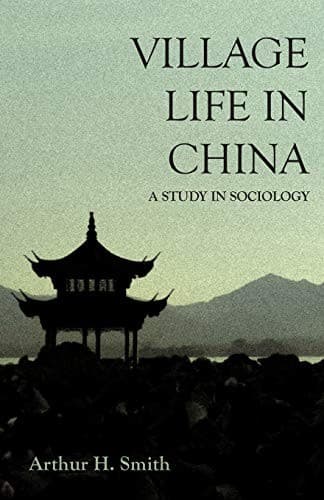
Village Life in China: A Study in SociologySmith, Arthur H.
General
Village Life in China: A Study in Sociology
Smith, Arthur H.
China -- Social life and customs; Villages
[1] A consideration of the important crisis through which the Chinese
Empire is passing at the close of the century, does not fall within the
scope of a work like the present. All who are interested in that subject
should not omit to read attentively Mr. Colquhoun's "China in
Transformation," London and New York, 1898, embodying the matured
convictions of an accomplished traveller, and an experienced Oriental
administrator, with an exceptional first-hand acquaintance with China.
[2] A Chinese woman for many years employed in the writer's family,
remarked that for a long time after she was married she was never allowed
to leave the narrow courtyard in her hamlet. The wife of a Tao-t'ai told a
foreign lady that in her next existence she hoped to be born _a dog_, that
she might go where she chose!
[3] We have known occasional instances in which a betrothed girl was not
required to attend the funeral of her future father-in-law or
mother-in-law, a trying ordeal which she must be glad to escape. Sometimes
when she does attend, she merely kneels to the coffin, but does not
"lament," for usage is in this, as in other particulars, very capricious.
[4] A Chinese woman whose parents are living, is constantly referred to
not only as a "girl," but as an unmarried girl (_ku-niang_), although she
may be herself the mother of half-a-dozen children.
[5] See a small pamphlet on "The Status of Woman in China," by Dr. Ernst
Faber, Shanghai, 1889, containing many illustrative classical citations.
[6] For ample illustration of this subject see Dr. Ernst Faber's "The
Famous Women of China," Shanghai, 1890, and "Typical Women of China," by
the late Miss A. C. Safford, an abridged translation of a famous and
authoritative Chinese work.
[7] An extreme case of chronic misery from this cause is found in the
Hsiên District of Chih-li, where there is a section wedged in between the
high artificial banks of two rivers. Every year many villages are deluged
as matter of course, and the houses have been repeatedly destroyed. No
autumn crop can ever be raised here, but wheat is put in after the waters
have subsided. In the winter one sees many of the houses with doors and
windows plastered up, almost all the inhabitants having gone off in droves
to beg a living where they can, returning the next spring to look after
their wheat. This has become a regular practice even with families who own
fifty or sixty acres of land, and who elsewhere would be called well off.
Public-domain text, read in full here on John Shaqi.
Reviews
Reviews
No reviews yet
Be the first to share your thoughts on this work.
Elsewhere in the archive
Join the Discussion
Join the discussion
Sign in to leave a comment or review.
Sign InorCreate an account