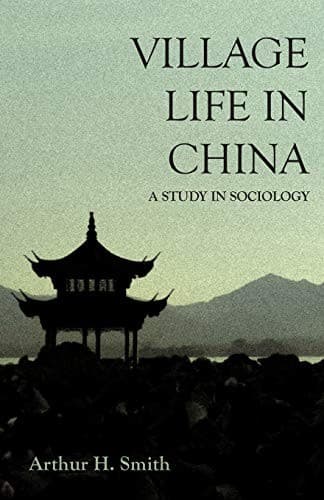
Village Life in China: A Study in SociologySmith, Arthur H.
General
Village Life in China: A Study in Sociology
Smith, Arthur H.
China -- Social life and customs; Villages
In Shan-tung, every village of any size has its little "tsa-huo-p'u," or
shop of miscellaneous goods. It is not at all like a huckster's shop at
home, for the goods kept are not intended to be disposed of at once. Many
of them may remain in stock for many years, but they will probably all be
worked off at last. Occidentals often suppose that the Chinese live on
"curry and rice." Very few people in Shan-tung ever tasted rice in their
lives, but there is generally a small quantity kept at the "tsa-huo-p'u"
in case there should be a call for use at feasts, or for the sick. There
is a good supply of red paper used for cards of invitation, and white
paper for funeral announcements, the need for which must be met promptly,
without waiting for a trip to a distant market-town. Besides this there is
a large stock of fire-crackers which are wanted whenever there is a
feast-day, a wedding or a funeral, and also paper money and other
materials for the idolatrous ceremonies which these occasions involve.
There are many other kinds of wares, for there is almost nothing for which
a demand may not be made; but the greatest profit is derived from the
articles last named.
Let not the reader, inexpert in Chinese affairs, suppose that the keeper
of the "tsa-huo-p'u" sits all day in a chair awaiting customers, or spends
the intervals between their infrequent arrivals in playing Chinese fox and
geese or chess. He does nothing of the kind. If his shop is a very small
one it is not tended at all, but simply open when occasion serves. If it
is a larger affair, it requires the time of more than one person, not to
tend it but to carry on the rural trade. For the larger part of the
business of the "tsa-huo-p'u" is not at home, but at five-day markets all
about. The proprietors of some shops take their wares to a fair every day
in the month, on the first and sixth to one place, on the second and
seventh to another, on the third and eighth to another, and on the fifth
and tenth to still another, by which time the circle is completed.
Going to one of these markets is no holiday work. It is necessary to rise
either at daylight or before, select the goods to be taken, pack them
carefully, make an accurate list of them, and then wheel the barrow to the
fair, sometimes over very bad roads in very bad weather. Arrived at the
market-town there are no stalls or booths for the dealers to occupy, but
each plants himself in a spot for which he has to pay a small ground-rent
to the owner, who is always on hand to collect this rent. All day long the
barrow must be tended assiduously, bickering with all sorts and conditions
of men and women, and when the people have begun to scatter, the articles
must be packed up again, and the barrow wheeled home.
Public-domain text, read in full here on John Shaqi.
Reviews
Reviews
No reviews yet
Be the first to share your thoughts on this work.
Join the Discussion
Join the discussion
Sign in to leave a comment or review.
Sign InorCreate an account