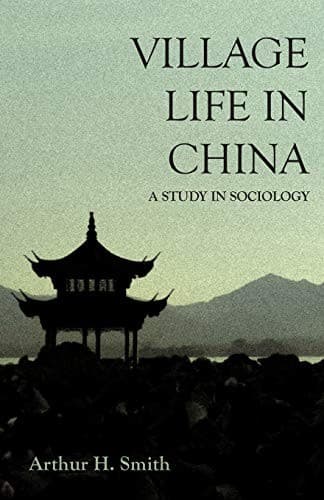
Village Life in China: A Study in Sociology — John Shaqi
Village Life in China: A Study in SociologySmith, Arthur H.
General
Village Life in China: A Study in Sociology
Smith, Arthur H.
China -- Social life and customs; Villages
The players are divided into classes which are called by different names,
the members of each class receiving pay according to the dignity of their
position. There are, for example, two individuals, one civil and one
military, who represent high-class historical characters, like Chiang
T'ai-kung, etc. These actors are called _lao-shêng_. Another class styled
_hu-shêng_, represent personages like Wên Wang, or Chao K'uang-yin. A
third class are assigned to characters like Lü Pu, etc., and these players
are called _hsiao-shêng_. In addition to these are persons of less
importance, who represent ladies, officials' wives, young girls, or
others. After these come what may be called clowns, who are termed
"flowery-faced," (_hua-lien_) subdivided into first, second and third.
These represent the bad characters, such as Chou Wang, Ts'ao Ts'ao, and
the like, down to the lowest class who take the most despised and hateful
parts of all. In addition to these main characters, there is a
considerable force detailed as soldiers, servants, messengers, or to
personify boatmen, innkeepers, and the like. The rear is brought up with
a large staff of cooks, water-carriers, etc., whose duty it is to provide
for the material comfort of the players in their vagrant life.
Aside from the regular theatrical companies one frequently meets with
companies of amateurs who have inherited the art of giving performances on
a small scale called "a little theatre." They are young farmers who
delight in the change and excitement of stage life, and who after the
crops are harvested are open to engagements until the spring work begins.
There may be only fifteen or twenty in the band, but the terms are low,
and the food furnished them much better than they would have had at home,
and when the season is over they may be able to divide a snug little sum
to each performer.
The manager, or lessee of the theatrical equipment, is called a
_chang-pan_, and engages the players for a term of about ten months,
beginning early in the spring, and ending before the close of the year.
The whole company may number between fifty and a hundred men, and the best
actors may be engaged for sums ranging from the equivalent of a hundred
dollars for the most skilled, down to a few tens of dollars for the
inferior actors, their food in each case being furnished. It is thus easy
to see that the expense of maintaining a theatre is a vast drain upon the
resources of the lessee, and presupposes a constant succession of
profitable engagements, which is a presupposition not infrequently at a
great remove from the facts of experience.
Public-domain text, read in full here on John Shaqi.
Reviews
Reviews
No reviews yet
Be the first to share your thoughts on this work.
Join the Discussion
Join the discussion
Sign in to leave a comment or review.
Sign InorCreate an account