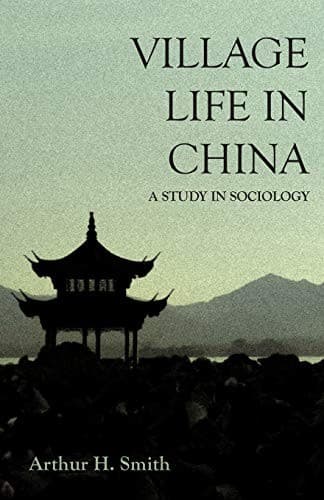
Village Life in China: A Study in SociologySmith, Arthur H.
General
Village Life in China: A Study in Sociology
Smith, Arthur H.
China -- Social life and customs; Villages
It is one of the contradictions which abound in the Chinese social life,
that while play-actors are theoretically held in very light esteem, the
representation of a play is considered as a great honour to the person on
whose behalf it is furnished. Instances have occurred in China, in which
such a representation has been offered by the Chinese to foreigners, as an
expression of gratitude for help received in time of famine. The motives
in such cases, however were probably very mixed, being composed largely of
a desire on the part of the proposers to gratify their own tastes, while
at the same time paying off in a public manner a technical debt of
gratitude.
To suggest under such circumstances that the money which would have been
absorbed in the expenses of the theatre, should rather be appropriated to
the purposes of some public benefit, such as a free-school, would not
commend itself to one Chinese in a thousand. Only a limited number of
scholars could receive the benefit of a free-school, whereas a theatre is
emphatically for everybody. Moreover, a theatre is demonstrative and
obtrusively thrusts itself upon the attention of the general public in a
manner which to the Oriental is exceedingly precious, while to set up a
free-school would be "to wear a fine garment in the dark," when no one
would know the difference.
The occasion for the performance of a play is sometimes a vow, which may
have been made by an individual in time of sickness, the theatricals to be
the expression of gratitude for recovery. In the case of an entire
village, it is often the returning of thanks to some divinity for a good
harvest, or for a timely rain. A quarrel between individuals is frequently
composed by the adjudication of "peace-talkers" that one of the parties
shall give a theatrical exhibition by way of a fine, in the benefits of
which the whole community may thus partake. In view of the well-known
propensities of the Chinese, it is not strange that this method of
adjusting disputes is very popular. We have known it to be adopted by a
District Magistrate in settling a lawsuit between two villages, and such
cases are probably not uncommon.
Sometimes there is no better reason for holding a theatre than that a sum
of public money has accumulated, which there is no other way to spend. A
foreigner could easily propose fifty purposes to which the funds could be
appropriated to much better advantage, but to the Chinese these
suggestions always appear untimely, not to say preposterous.
Public-domain text, read in full here on John Shaqi.
Reviews
Reviews
No reviews yet
Be the first to share your thoughts on this work.
Join the Discussion
Join the discussion
Sign in to leave a comment or review.
Sign InorCreate an account