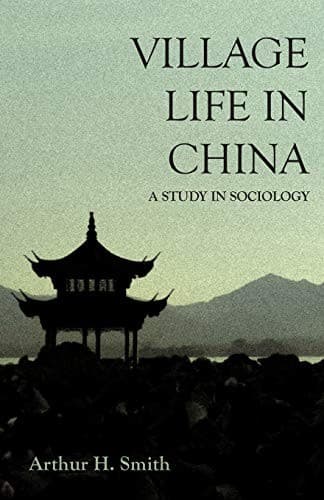
Village Life in China: A Study in SociologySmith, Arthur H.
General
Village Life in China: A Study in Sociology
Smith, Arthur H.
China -- Social life and customs; Villages
After the Four Books, follow in varying order the Poetical Classic, the
Book of History, the Book of Changes, and the historical work of
Confucius, known as the Spring and Autumn Annals. To commit to memory all
these volumes, must in any case be the labour of many years. Usage varies
in different localities, but it is very common to find scholars who have
memorized the whole of the Four Books, and perhaps two of the later
Classics--the Odes and the History--before they have heard any
explanations even of the Trimetrical Classic, with which their education
began. During all these years, the pupil has been in a condition of mental
daze, which is denoted by a Chinese character, the component parts of
which signify a pig in the weeds (mêng). His entrance upon study is called
"lifting the darkness" (ch'i mêng), and to teach the beginner is to
"instruct darkness." These expressive phrases correspond to a fixed
reality. Of those who have committed to memory all the books named, some
of the brightest have no doubt picked up here and there, and as it were by
accident, an idea.
Thoughtful Chinese teachers, familiar with the capacity of their pupils,
estimate that the most intelligent among them can not be expected to
understand a hundredth part of what they have memorized. The great
majority of them have about as accurate a conception of the territory
traversed, as a boy might entertain of a mountainous district through
which he had been compelled to run barefooted and blindfolded in a dense
fog, chased for vast distances by a man cracking over his head a long
ox-whip. How very little many scholars do grasp of the real meaning, even
after explanations which the teacher regards as abundantly full, is
demonstrated by a test to which here and there a master subjects his
scholars, that of requiring them to write down a passage. The result is
frequently the notation of so many false characters as to render it
evident, not only that the explanations have not been apprehended, but
that notwithstanding such a multitude of perusals, the text itself has
been taken only into the ear as so many sounds, and has not entered the
mind at all.
Public-domain text, read in full here on John Shaqi.
Reviews
Reviews
No reviews yet
Be the first to share your thoughts on this work.
Elsewhere in the archive
Join the Discussion
Join the discussion
Sign in to leave a comment or review.
Sign InorCreate an account