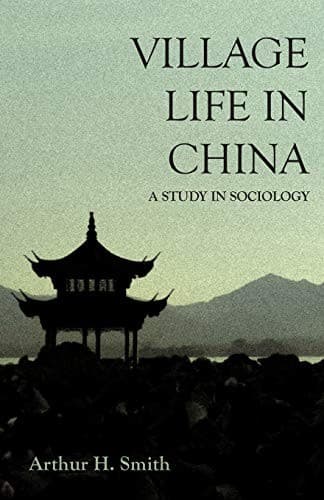
Village Life in China: A Study in SociologySmith, Arthur H.
General
Village Life in China: A Study in Sociology
Smith, Arthur H.
China -- Social life and customs; Villages
The system of explanations adopted by Chinese teachers, as a rule, is
almost the exact opposite of that which, to an Occidental, would seem
rational. "In speech," said Confucius, "one should be intelligible, and
that is the end of it." The Confucian teacher, however, is often very far
indeed from feeling that it is necessary to be intelligible--that is to
say, to make it absolutely certain that his pupils have fully comprehended
his meaning. He is very apt to deliver his explanations--when a sufficient
number of years has elapsed to make it seem worth while to begin them at
all--_ex cathedra_, and in a stately, formal manner, his attention being
much more fixed upon the exhibition of his own skill in displaying his own
knowledge, than upon imparting that knowledge to his scholars. It is
common to hear it said of a teacher who has attained distinction, that
when he opens his mouth to explain the Classics, "every sentence is fit
for an examination essay." This is considered to be the acme of praise.
Sentences which are suited to be constituent parts of examination essays,
are not, it is superfluous to remark, particularly adapted to the
comprehension of young schoolboys, who know nothing about examination
essays, the style of which is utterly beyond their powers.
The commentary upon the Classics written by Chu Hsi, in the twelfth
century, A. D., has come to have an authority second only to that of the
text itself. That no Chinese school-teacher leads his pupils to question
for an instant whether the explanation is accurate and adequate, is a
matter of course. The whole object of a teacher's work is to fit his
pupils to compete at the examinations, and to prepare essays which shall
win the approval of the examiners, thus leading to the rank of literary
graduate. This result would be possible only to those who accept the
orthodox interpretation of the Classics, and hence it is easy to see that
Chinese schools are not likely to become nurseries of heresy. The very
idea of discussing with his pupils either text or commentary, does not so
much as enter the mind of a Chinese schoolmaster. He could not do so if he
would, and he would not if he could.
The task of learning to write Chinese characters is a very serious one, in
comparison with which it is scarcely unfair to characterize the mastery of
the art of writing any European language, as a mere pastime. The correct
notation of characters is, moreover, not less important than the correct
recognition of them, for success in some of the examinations is made to
depend as much upon caligraphy as upon style.
The characters which the teacher selects for the writing exercises of his
pupils, have no relation, strange as it may seem, to anything which he is
studying. These characters may at first be taken from little books of
rhymes arranged for the purpose, containing characters at once simple and
common.
Public-domain text, read in full here on John Shaqi.
Reviews
Reviews
No reviews yet
Be the first to share your thoughts on this work.
Elsewhere in the archive
Join the Discussion
Join the discussion
Sign in to leave a comment or review.
Sign InorCreate an account