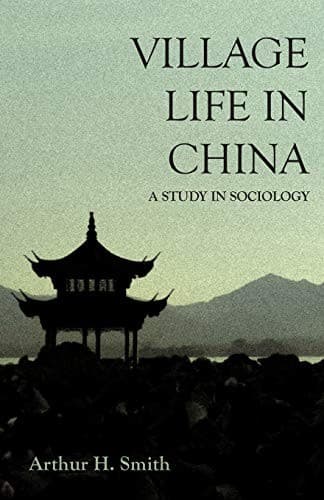
Village Life in China: A Study in SociologySmith, Arthur H.
General
Village Life in China: A Study in Sociology
Smith, Arthur H.
China -- Social life and customs; Villages
As the Chinese child has no Saturdays, no Sundays, no recesses, no variety
of study, and no promotion from grade to grade, nor from one school to
another, it is probable that he has enough schooling such as it is. As
every scholar is a class by himself, the absence of one does not interfere
with the study of another. Even if two lads happen to be reciting in the
same place, they have no more connection with each other than any other
two pupils. Of such a thing as classification the teacher has never heard,
and the irregular attendance of the scholars would, he tells you, prevent
it, even were it otherwise possible. Owing to the time required to hear so
many recitations, an ordinary school does not contain more than eight or
ten pupils, and twenty are regarded as beyond one teacher's capacity.
There is very little which is really intellectual in any part of the early
schooling of an ordinary Chinese boy. As a rule, the teacher does not
concern himself with his pupils further than to drag them over a specified
course, or at least to attempt to do so. The parents of the lad are
equally indifferent, or even more so. If the father himself can read, he
remembers that he learned to do so by a long and thorny road, and he
thinks it proper that his son should traverse it likewise. If the father
can not read, he at least recognizes the fact that he knows nothing at all
about the matter, and that it is not _his_ business to interfere. The
teacher is hired to teach--let him do it. As for visiting the school to
see what progress his son is making, he never heard of such a thing, and
he would not do it if he had heard of it. The teacher would say in his
manner if not in his words, "_What business have you here?_"
A sufficient reason for spending all his time in the schoolroom is the
fact that it is practically impossible for a Chinese child to do any
studying amid the distractions of a Chinese household. Even for adult
scholars it is almost always difficult to do so. At his home the pupil has
no mental stimulus of any sort, no books, magazines or papers, and even if
he had them, his barren studies at school would not have fitted him to
comprehend such literature.
The object of Chinese education is to pump up the wisdom of the ancients
into the minds of the moderns. In order to do this, however, it is
necessary to keep the stream in a constant flow, at whatever cost, else
much of the preceding labour is lost. According to Chinese theory, or
practice, a school which should only be in session for six months of the
year, would be a gross absurdity. The moment a child fails to attend
school, he is supposed (and with reason) to become "wild."
Public-domain text, read in full here on John Shaqi.
Reviews
Reviews
No reviews yet
Be the first to share your thoughts on this work.
Elsewhere in the archive
Join the Discussion
Join the discussion
Sign in to leave a comment or review.
Sign InorCreate an account