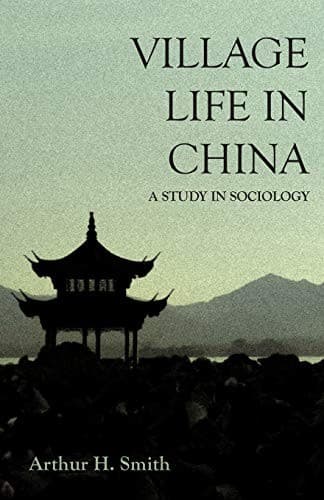
Village Life in China: A Study in SociologySmith, Arthur H.
General
Village Life in China: A Study in Sociology
Smith, Arthur H.
China -- Social life and customs; Villages
Considering what, in spite of their defects, the Classics have done for
China, it is not surprising that they have come to be regarded with a
bibliolatry to which the history of mankind affords few parallels. It is
extremely difficult for us to comprehend the effect of a narrow range of
studies on the mind, because our experience furnishes no instance to which
the case of the Chinese can be compared. Let us for a moment imagine a
Western scholar, who had enjoyed a profound mathematical education, and no
other education whatever. Every one would consider such a mind
ill-balanced. Yet much of the ill effect of such a narrow education would
be counteracted. Mathematical certainty is infallible certainty;
mathematics leads up to astronomy, and a thorough acquaintance with
astronomy is of itself a liberal education. Besides this, no man in
Western lands can fail to come into vital contact with other minds. And
there is what Goethe called the Zeit-geist, or Spirit of the Age, which
exerts a powerful influence upon him. But in China, a man who is educated
in a narrow line, is likely, though by no means certain, to remain narrow,
and there is no Chinese Zeit-geist, or if there is, like other ghosts, it
seldom interposes in human affairs.
The average Chinese scholar is at a great disadvantage in the lack of the
apparatus for study. In a Western land, any man with the slightest claim
to be called a scholar, would be able to answer in a short time, a vast
range of questions, with intelligent accuracy. This he would do, not so
much by means of his own miscellaneous information, as by his books of
reference. The various theories as to the location of the Garden of Eden,
the dimensions of the Great Pyramid, the probable authorship of the
Junius Letters, the highest latitude reached in polar exploration, the
names of the generals who conducted the fourth Peloponnesian war--all
these, and thousands of similar matters, could be at once elucidated by
means of a dictionary of antiquities, a manual of ancient or modern
history, a biographical dictionary, and an encyclopedia. To the ordinary
Chinese scholar, such helps as these are entirely wanting. He owns very
few books; for in the country where printing was invented, books are the
luxury of the rich.
The standard dictionary of Chinese, is that compiled two centuries ago in
the K'ang Hsi period, and is alleged to contain 44,449 characters, but of
these an immense number are obsolete and synonomous, and only serve the
purpose of bewildering the student. Within the past two generations the
Chinese language has undergone a remarkable development, owing to the
contact of China with her neighbours. All the modern sciences have
obtruded themselves, but there is no interest in the coördination of these
new increments to their language on the part of Chinese scholars, to whom
K'ang Hsi's lexicon is amply sufficient.
Public-domain text, read in full here on John Shaqi.
Reviews
Reviews
No reviews yet
Be the first to share your thoughts on this work.
Elsewhere in the archive
Join the Discussion
Join the discussion
Sign in to leave a comment or review.
Sign InorCreate an account