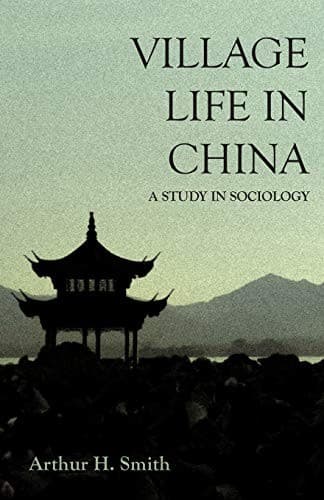
Village Life in China: A Study in SociologySmith, Arthur H.
General
Village Life in China: A Study in Sociology
Smith, Arthur H.
China -- Social life and customs; Villages
In order to attain success in Chinese composition, it is necessary to be
acquainted with the force of every character, as a means to which, access
to this standard dictionary, would seem to be indispensable. Yet, though
invaluable, it is not in the possession of one scholar in fifty. Its place
is generally taken by a small compendium, analogous to what we should call
a pocket-manual, in which the characters are arranged according to the
sound, and not according to the radicals, as in K'ang Hsi.
Pupils are seldom taught the 214 radicals, and many persons who have spent
years at school have no idea how to use K'ang Hsi's dictionary, when it is
put into their hands. Within a circle of eight or ten villages, there may
be only a single copy, and if it is necessary to obtain more accurate
information than is to be had in the pocket-dictionary, the inquirer must
go to the village where there is a copy of K'ang Hsi, and "borrow light"
there.
But such an extreme measure is seldom considered necessary. The incessant
study of the Classics has made all the characters in them familiar. Those
who write essays can compose them with the aid of these characters only,
and as for miscellaneous characters--that is, those not found in the
Classics--why should one care for _them_? A good edition of K'ang Hsi,
with clear type and no false characters, might cost, if new, as much as
the village schoolmaster would receive for his whole year's work.
At examinations below that for the second degree, a knowledge of history
is said to be as superfluous as an acquaintance with the dictionary. Nine
out of ten candidates at the lower examinations know little of the history
of China, except what they have learned from the Trimetrical Classic, or
picked up from the classics. The perusal of compendiums of history, even
if such are available, is the employment of leisure, and the composition
of essays as a business once entered upon, there is no leisure.
One occasionally meets a teacher who has made a specialty of history, but
these men are rare. Historical allusions often lie afloat in the minds of
Chinese scholars, like snatches of poetry, the origin and connection of
which are unknown. Many scholars who have the knack of picking up and
appropriating such spiculæ of knowledge, acquire the art of dextrously
weaving them into examination essays and owe their success to this
circumstance alone, whereas if they were examined upon the historical
connection of the incidents which they have thus cited, they would be
unable to reply. But as long as the use of such allusions in essays is
felicitous, no questions are asked, and the desired end is attained. "The
Cat that catches the Rat is a good Cat," says the adage, and it is no
matter if the Cat is blind, and the Rat is a dead one!
Public-domain text, read in full here on John Shaqi.
Reviews
Reviews
No reviews yet
Be the first to share your thoughts on this work.
Elsewhere in the archive
Join the Discussion
Join the discussion
Sign in to leave a comment or review.
Sign InorCreate an account