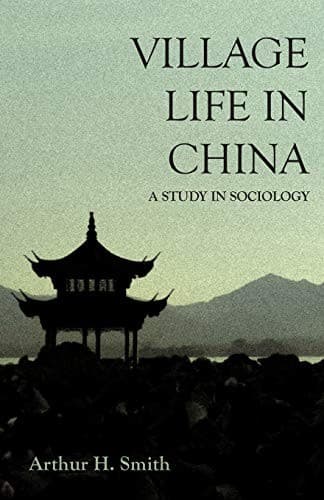
Village Life in China: A Study in SociologySmith, Arthur H.
General
Village Life in China: A Study in Sociology
Smith, Arthur H.
China -- Social life and customs; Villages
In the Village School, however, it is within bounds to estimate that not
one in twenty of the scholars--and more probably, not three in a
hundred--have any reasonable prospect of carrying their studies to
anything like this point. The practical result, therefore, is to compel at
least ninety-seven scholars to pursue a certain routine, simply because it
is the only known method by which three other scholars can compete for a
degree. In other words, nineteen pupils are compelled to wear a heavy
cast-iron yoke, in order to keep company with a twentieth, who is trying
to get used to it as a step towards obtaining a future name! If this
inconvenient inequality is pointed out to teachers or to patrons, and if
they are asked whether it would not be better to adopt, for the nineteen
who will never go to the examinations, a system which involves less
memorizing, and a wider range of learning in the brief time which is all
that most of the pupils can spend at school, they reply, with perfect
truth, that so far as they are aware there is no other system; that even
if the patrons desired to make the experiment (which would never be the
case), they could find no teacher to conduct it; and that even if a
teacher should wish to institute such a reform (which would never happen),
he would find no one to employ him.
The extreme difficulty which men of some education often find in keeping
from starvation, gives rise to a class of persons known as Strolling
Scholars, (_yu hsiao_), who travel about the country vending paper,
pictures, lithographs of tablets, pens and ink. These individuals are not
to be confounded with travelling pedlars, who, though they deal in the
same articles, make no pretension to learning, and generally convey their
goods on a wheelbarrow, whereas the Strolling Scholar cannot manage
anything larger than a pack.
When a Strolling Scholar reaches a schoolhouse, he enters, lowers his
bundle, and makes a profound bow to the teacher, who (though much
displeased at his appearance) must return the courtesy. If there are large
pupils, the stranger bows to them and addresses them as his Younger
Brothers. The teacher then makes some inquiries as to his name, etc. If he
turns out to be a mere pretender, without real scholarship, the teacher
drops the conversation, and very likely leaves the schoolroom. This is a
tacit signal to the larger scholars to get rid of the visitor. They place
a few cash on the table, perhaps not more than five, or even three, which
the Strolling Scholar picks up, and with a bow departs. If he sells
anything, his profits are of the most moderate description--perhaps three
cash on each pen, and two cash on each cake of ink. With a view to this
class of demands, a small fund is sometimes kept on hand by the larger
scholars, who compel the younger ones to contribute to it.
Public-domain text, read in full here on John Shaqi.
Reviews
Reviews
No reviews yet
Be the first to share your thoughts on this work.
Elsewhere in the archive
Join the Discussion
Join the discussion
Sign in to leave a comment or review.
Sign InorCreate an account