Autobiographical fiction; British -- Belgium -- Fiction; Brussels (Belgium) -- Fiction; Love stories; Women teachers -- Fiction
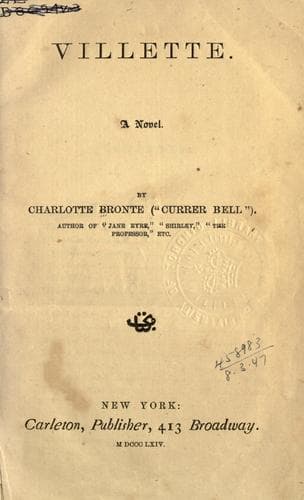
Villette
by Charlotte Brontë
Contents
I. BRETTON
II. PAULINA
III. THE PLAYMATES
IV. MISS MARCHMONT
V. TURNING A NEW LEAF
VI. LONDON
VII. VILLETTE
VIII. MADAME BECK
IX. ISIDORE
X. DR. JOHN
XI. THE PORTRESS’S CABINET
XII. THE CASKET
XIII. A SNEEZE OUT OF SEASON
XIV. THE FÊTE
XV. THE LONG VACATION
XVI. AULD LANG SYNE
XVII. LA TERRASSE
XVIII. WE QUARREL
XIX. THE CLEOPATRA
XX. THE CONCERT
XXI. REACTION
XXII. THE LETTER
XXIII. VASHTI
XXIV. M. DE BASSOMPIERRE
XXV. THE LITTLE COUNTESS
XXVI. A BURIAL
XXVII. THE HÔTEL CRÉCY
XXVIII. THE WATCHGUARD
XXIX. MONSIEUR’S FÊTE
XXX. M. PAUL
XXXI. THE DRYAD
XXXII. THE FIRST LETTER
XXXIII. M. PAUL KEEPS HIS PROMISE
XXXIV. MALEVOLA
XXXV. FRATERNITY
XXXVI. THE APPLE OF DISCORD
XXXVII. SUNSHINE
XXXVIII. CLOUD
XXXIX. OLD AND NEW ACQUAINTANCE
XL. THE HAPPY PAIR
XLI. FAUBOURG CLOTILDE
XLII. FINIS
VILLETTE.
CHAPTER I.
BRETTON.
My godmother lived in a handsome house in the clean and ancient town of
Bretton. Her husband’s family had been residents there for generations,
and bore, indeed, the name of their birthplace—Bretton of Bretton:
whether by coincidence, or because some remote ancestor had been a
personage of sufficient importance to leave his name to his
neighbourhood, I know not.
When I was a girl I went to Bretton about twice a year, and well I
liked the visit. The house and its inmates specially suited me. The
large peaceful rooms, the well-arranged furniture, the clear wide
windows, the balcony outside, looking down on a fine antique street,
where Sundays and holidays seemed always to abide—so quiet was its
atmosphere, so clean its pavement—these things pleased me well.
One child in a household of grown people is usually made very much of,
and in a quiet way I was a good deal taken notice of by Mrs. Bretton,
who had been left a widow, with one son, before I knew her; her
husband, a physician, having died while she was yet a young and
handsome woman.
She was not young, as I remember her, but she was still handsome, tall,
well-made, and though dark for an Englishwoman, yet wearing always the
clearness of health in her brunette cheek, and its vivacity in a pair
of fine, cheerful black eyes. People esteemed it a grievous pity that
she had not conferred her complexion on her son, whose eyes were
blue—though, even in boyhood, very piercing—and the colour of his long
hair such as friends did not venture to specify, except as the sun
shone on it, when they called it golden. He inherited the lines of his
mother’s features, however; also her good teeth, her stature (or the
promise of her stature, for he was not yet full-grown), and, what was
better, her health without flaw, and her spirits of that tone and
equality which are better than a fortune to the possessor.
Public-domain text, read in full here on John Shaqi.
Reviews
Reviews
No reviews yet
Be the first to share your thoughts on this work.
Join the Discussion
Join the discussion
Sign in to leave a comment or review.
Sign InorCreate an account