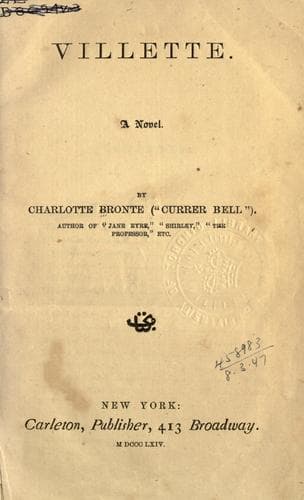
Autobiographical fiction; British -- Belgium -- Fiction; Brussels (Belgium) -- Fiction; Love stories; Women teachers -- Fiction
“Taisez-vous!” Madame would reply, heroically and inexorably. “Vous ne
passerez pas à moins que ce ne soit sur mon cadavre, et vous ne
danserez qu’avec la nonnette du jardin” (alluding to the legend). And
she majestically walked to and fro along their disconsolate and
impatient line, like a little Bonaparte in a mouse-coloured silk gown.
Madame knew something of the world; Madame knew much of human nature. I
don’t think that another directress in Villette would have dared to
admit a “jeune homme” within her walls; but Madame knew that by
granting such admission, on an occasion like the present, a bold stroke
might be struck, and a great point gained.
In the first place, the parents were made accomplices to the deed, for
it was only through their mediation it was brought about. Secondly: the
admission of these rattlesnakes, so fascinating and so dangerous,
served to draw out Madame precisely in her strongest character—that of
a first-rate _surveillante_. Thirdly: their presence furnished a most
piquant ingredient to the entertainment: the pupils knew it, and saw
it, and the view of such golden apples shining afar off, animated them
with a spirit no other circumstance could have kindled. The children’s
pleasure spread to the parents; life and mirth circulated quickly round
the ball-room; the “jeunes gens” themselves, though restrained, were
amused: for Madame never permitted them to feel dull—and thus Madame
Beck’s fête annually ensured a success unknown to the fête of any other
directress in the land.
I observed that Dr. John was at first permitted to walk at large
through the classes: there was about him a manly, responsible look,
that redeemed his youth, and half-expiated his beauty; but as soon as
the ball began, Madame ran up to him.
“Come, Wolf; come,” said she, laughing: “you wear sheep’s clothing, but
you must quit the fold notwithstanding. Come; I have a fine menagerie
of twenty here in the carré: let me place you amongst my collection.”
“But first suffer me to have one dance with one pupil of my choice.”
“Have you the face to ask such a thing? It is madness: it is impiety.
Sortez, sortez, au plus vite.”
She drove him before her, and soon had him enclosed within the cordon.
Ginevra being, I suppose, tired with dancing, sought me out in my
retreat. She threw herself on the bench beside me, and (a demonstration
I could very well have dispensed with) cast her arms round my neck.
“Lucy Snowe! Lucy Snowe!” she cried in a somewhat sobbing voice, half
hysterical.
“What in the world is the matter?” I drily said.
“How do I look—how do I look to-night?” she demanded.
“As usual,” said I; “preposterously vain.”
“Caustic creature! You never have a kind word for me; but in spite of
you, and all other envious detractors, I know I am beautiful; I feel
it, I see it—for there is a great looking-glass in the dressing-room,
where I can view my shape from head to foot. Will you go with me now,
and let us two stand before it?”
Public-domain text, read in full here on John Shaqi.
Reviews
Reviews
No reviews yet
Be the first to share your thoughts on this work.
Elsewhere in the archive
Join the Discussion
Join the discussion
Sign in to leave a comment or review.
Sign InorCreate an account