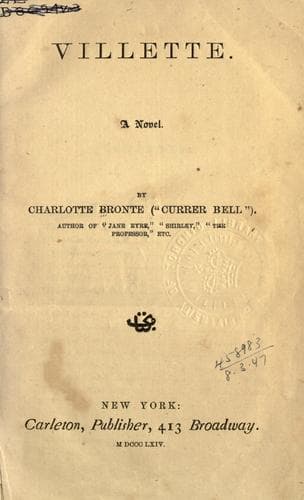
Autobiographical fiction; British -- Belgium -- Fiction; Brussels (Belgium) -- Fiction; Love stories; Women teachers -- Fiction
His chastiser could not bear the suggestion. She was beside him
directly.
“Let me see your eye: I did not mean to touch it, only your mouth; and
I did not think I hit so _very_ hard.”
Silence answered her. Her features worked,—“I am sorry; I am sorry!”
Then succeeded emotion, faltering; weeping.
“Have done trying that child, Graham,” said Mrs. Bretton.
“It is all nonsense, my pet,” cried Mr. Home.
And Graham once more snatched her aloft, and she again punished him;
and while she pulled his lion’s locks, termed him—“The naughtiest,
rudest, worst, untruest person that ever was.”
On the morning of Mr. Home’s departure, he and his daughter had some
conversation in a window-recess by themselves; I heard part of it.
“Couldn’t I pack my box and go with you, papa?” she whispered
earnestly.
He shook his head.
“Should I be a trouble to you?”
“Yes, Polly.”
“Because I am little?”
“Because you are little and tender. It is only great, strong people
that should travel. But don’t look sad, my little girl; it breaks my
heart. Papa, will soon come back to his Polly.”
“Indeed, indeed, I am not sad, scarcely at all.”
“Polly would be sorry to give papa pain; would she not?”
“Sorrier than sorry.”
“Then Polly must be cheerful: not cry at parting; not fret afterwards.
She must look forward to meeting again, and try to be happy meanwhile.
Can she do this?”
“She will try.”
“I see she will. Farewell, then. It is time to go.”
“_Now_?—just _now_?
“Just now.”
She held up quivering lips. Her father sobbed, but she, I remarked, did
not. Having put her down, he shook hands with the rest present, and
departed.
When the street-door closed, she dropped on her knees at a chair with a
cry—“Papa!”
It was low and long; a sort of “Why hast thou forsaken me?” During an
ensuing space of some minutes, I perceived she endured agony. She went
through, in that brief interval of her infant life, emotions such as
some never feel; it was in her constitution: she would have more of
such instants if she lived. Nobody spoke. Mrs. Bretton, being a mother,
shed a tear or two. Graham, who was writing, lifted up his eyes and
gazed at her. I, Lucy Snowe, was calm.
The little creature, thus left unharassed, did for herself what none
other could do—contended with an intolerable feeling; and, ere long, in
some degree, repressed it. That day she would accept solace from none;
nor the next day: she grew more passive afterwards.
On the third evening, as she sat on the floor, worn and quiet, Graham,
coming in, took her up gently, without a word. She did not resist: she
rather nestled in his arms, as if weary. When he sat down, she laid her
head against him; in a few minutes she slept; he carried her upstairs
to bed. I was not surprised that, the next morning, the first thing she
demanded was, “Where is Mr. Graham?”
Public-domain text, read in full here on John Shaqi.
Reviews
Reviews
No reviews yet
Be the first to share your thoughts on this work.
Join the Discussion
Join the discussion
Sign in to leave a comment or review.
Sign InorCreate an account