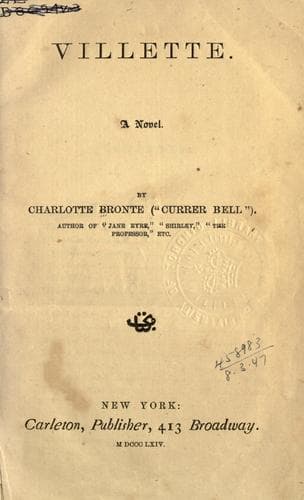
Autobiographical fiction; British -- Belgium -- Fiction; Brussels (Belgium) -- Fiction; Love stories; Women teachers -- Fiction
In going to London, I ran less risk and evinced less enterprise than
the reader may think. In fact, the distance was only fifty miles. My
means would suffice both to take me there, to keep me a few days, and
also to bring me back if I found no inducement to stay. I regarded it
as a brief holiday, permitted for once to work-weary faculties, rather
than as an adventure of life and death. There is nothing like taking
all you do at a moderate estimate: it keeps mind and body tranquil;
whereas grandiloquent notions are apt to hurry both into fever.
Fifty miles were then a day’s journey (for I speak of a time gone by:
my hair, which, till a late period, withstood the frosts of time, lies
now, at last white, under a white cap, like snow beneath snow). About
nine o’clock of a wet February night I reached London.
My reader, I know, is one who would not thank me for an elaborate
reproduction of poetic first impressions; and it is well, inasmuch as I
had neither time nor mood to cherish such; arriving as I did late, on a
dark, raw, and rainy evening, in a Babylon and a wilderness, of which
the vastness and the strangeness tried to the utmost any powers of
clear thought and steady self-possession with which, in the absence of
more brilliant faculties, Nature might have gifted me.
When I left the coach, the strange speech of the cabmen and others
waiting round, seemed to me odd as a foreign tongue. I had never before
heard the English language chopped up in that way. However, I managed
to understand and to be understood, so far as to get myself and trunk
safely conveyed to the old inn whereof I had the address. How
difficult, how oppressive, how puzzling seemed my flight! In London for
the first time; at an inn for the first time; tired with travelling;
confused with darkness; palsied with cold; unfurnished with either
experience or advice to tell me how to act, and yet—to act obliged.
Into the hands of common sense I confided the matter. Common sense,
however, was as chilled and bewildered as all my other faculties, and
it was only under the spur of an inexorable necessity that she
spasmodically executed her trust. Thus urged, she paid the porter:
considering the crisis, I did not blame her too much that she was
hugely cheated; she asked the waiter for a room; she timorously called
for the chambermaid; what is far more, she bore, without being wholly
overcome, a highly supercilious style of demeanour from that young
lady, when she appeared.
I recollect this same chambermaid was a pattern of town prettiness and
smartness. So trim her waist, her cap, her dress—I wondered how they
had all been manufactured. Her speech had an accent which in its
mincing glibness seemed to rebuke mine as by authority; her spruce
attire flaunted an easy scorn to my plain country garb.
“Well, it can’t be helped,” I thought, “and then the scene is new, and
the circumstances; I shall gain good.”
Public-domain text, read in full here on John Shaqi.
Reviews
Reviews
No reviews yet
Be the first to share your thoughts on this work.
Join the Discussion
Join the discussion
Sign in to leave a comment or review.
Sign InorCreate an account