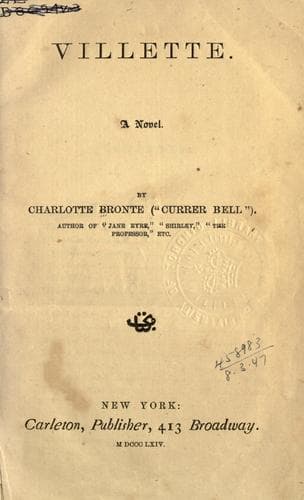
Autobiographical fiction; British -- Belgium -- Fiction; Brussels (Belgium) -- Fiction; Love stories; Women teachers -- Fiction
At dawn all were astir, and by sunrise the passengers came on board.
Boisterous was the welcome given by the stewardess to the “Watsons,”
and great was the bustle made in their honour. They were four in
number, two males and two females. Besides them, there was but one
other passenger—a young lady, whom a gentlemanly, though
languid-looking man escorted. The two groups offered a marked contrast.
The Watsons were doubtless rich people, for they had the confidence of
conscious wealth in their bearing; the women—youthful both of them, and
one perfectly handsome, as far as physical beauty went—were dressed
richly, gaily, and absurdly out of character for the circumstances.
Their bonnets with bright flowers, their velvet cloaks and silk
dresses, seemed better suited for park or promenade than for a damp
packet deck. The men were of low stature, plain, fat, and vulgar; the
oldest, plainest, greasiest, broadest, I soon found was the husband—the
bridegroom I suppose, for she was very young—of the beautiful girl.
Deep was my amazement at this discovery; and deeper still when I
perceived that, instead of being desperately wretched in such a union,
she was gay even to giddiness. “Her laughter,” I reflected, “must be
the mere frenzy of despair.” And even while this thought was crossing
my mind, as I stood leaning quiet and solitary against the ship’s side,
she came tripping up to me, an utter stranger, with a camp-stool in her
hand, and smiling a smile of which the levity puzzled and startled me,
though it showed a perfect set of perfect teeth, she offered me the
accommodation of this piece of furniture. I declined it of course, with
all the courtesy I could put into my manner; she danced off heedless
and lightsome. She must have been good-natured; but what had made her
marry that individual, who was at least as much like an oil-barrel as a
man?
The other lady passenger, with the gentleman-companion, was quite a
girl, pretty and fair: her simple print dress, untrimmed straw-bonnet
and large shawl, gracefully worn, formed a costume plain to quakerism:
yet, for her, becoming enough. Before the gentleman quitted her, I
observed him throwing a glance of scrutiny over all the passengers, as
if to ascertain in what company his charge would be left. With a most
dissatisfied air did his eye turn from the ladies with the gay flowers;
he looked at me, and then he spoke to his daughter, niece, or whatever
she was: she also glanced in my direction, and slightly curled her
short, pretty lip. It might be myself, or it might be my homely
mourning habit, that elicited this mark of contempt; more likely, both.
A bell rang; her father (I afterwards knew that it was her father)
kissed her, and returned to land. The packet sailed.
Public-domain text, read in full here on John Shaqi.
Reviews
Reviews
No reviews yet
Be the first to share your thoughts on this work.
Join the Discussion
Join the discussion
Sign in to leave a comment or review.
Sign InorCreate an account