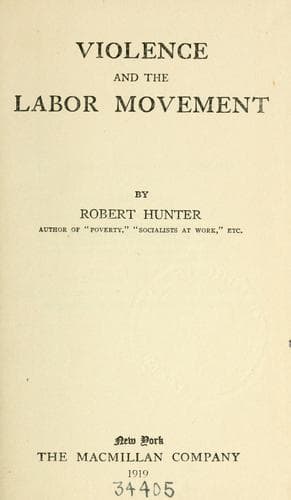
The socialist idea of revolution is quite a different one. Insurrection
plays no necessary part in it, and no one sees more clearly than the
socialist that nothing could prove more disastrous to the democratic
cause than to have the present class conflict break into a civil war. If
such a war becomes necessary, it will be in spite of the organized
socialists, who, in every country of the world, not only seek to avoid,
but actually condemn, riotous, tempestuous, and violent measures. Such
measures do not fit into their philosophy, which sees, as the cause of
our present intolerable social wrongs, not the malevolence of
individuals or of classes, but the workings of certain economic laws.
One can cut off the head of an individual, but it is not possible to cut
off the head of an economic law. From the beginning of the modern
socialist movement, this has been perfectly clear to the socialist,
whose philosophy has taught him that appeals to violence tend, as Engels
has pointed out, to obscure the understanding of the real development of
things.
The dissensions over the use of force, that have been so continuous and
passionate in the labor movement, arise from two diametrically opposed
points of view. One is at bottom anarchistic, and looks upon all social
evils as the result of individual wrong-doing. The other is at bottom
socialistic, and looks upon all social evils as in the main the result
of economic and social laws. To those who believe there are good trusts
and bad trusts, good capitalists and bad capitalists, and that this is
an adequate analysis of our economic ills, there is, of course, after
all, nothing left but hatred of individuals and, in the extreme case,
the desire to remove those individuals. To those, on the other hand, who
see in certain underlying economic forces the source of nearly all of
our distressing social evils, individual hatred and malice can make in
reality no appeal. This volume, on its historical side, as well as in
its survey of the psychology of the various elements in the labor
movement, is a contribution to the study of the reactions that affect
various minds and temperaments in the face of modern social wrongs. If
one's point of view is that of the anarchist, he is led inevitably to
make his war upon individuals. The more sensitive and sincere he is, the
more bitter and implacable becomes that war. If one's point of view is
based on what is now called the economic interpretation of history, one
is emancipated, in so far as that is possible for emotional beings, from
all hatred of individuals, and one sees before him only the necessity of
readjusting the economic basis of our common life in order to achieve a
more nearly perfect social order.
Public-domain text, read in full here on John Shaqi.
Reviews
Reviews
No reviews yet
Be the first to share your thoughts on this work.
Join the Discussion
Join the discussion
Sign in to leave a comment or review.
Sign InorCreate an account