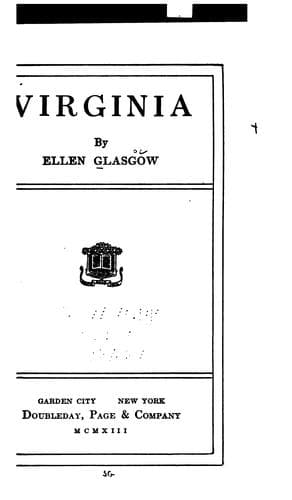
Marriage -- Fiction; Virginia -- Fiction; Wives -- Fiction; Women -- Fiction
"But the rector doesn't talk about sacrifice for the theatre," retorted
the teacher, and she added with crushing finality, "I don't believe
there is a particle of sense in it. If he is going to write, why on
earth doesn't he sit straight down and do it? Why, when little Miss
Amanda Sheppard was left at sixty without a roof over her head, she
began at once, without saying a word to anybody, to write historical
novels."
"It does seem funny until you talk with him," admitted Susan. "But he is
so much in earnest that when you listen to him, you can't help believing
in him. He is so full of convictions that he convinces you in spite of
yourself."
"Convictions about what?" demanded Miss Priscilla. "I don't see how a
young man who refuses to be confirmed can have any convictions."
"Well, he has, and he feels just as strongly about them as we do about
ours."
"But how can he possibly feel as strongly about a wrong conviction as we
do about a right one?" insisted the older woman stubbornly, for she
realized vaguely that they were approaching dangerous ground and set out
to check their advance in true Dinwiddie fashion, which was strictly
prohibitive.
"I like a man who has opinions of his own and isn't ashamed to stand up
for them," said Virginia with a resolution that made her appear suddenly
taller.
"Not _false_ opinions, Jinny!" rejoined Miss Priscilla, and her manner
carried them with a bound back to the schoolroom, for her mental vision
saw in a flash the beribboned diploma for good conduct which her
favourite pupil had borne away from the Academy on Commencement day two
years ago, and a shudder seized her lest she should have left a single
unprotected breach in the girl's mind through which an unauthorized idea
might enter. Had she trusted too confidently to the fact that Virginia's
father was a clergyman, and therefore spiritually armed for the defence
and guidance of his daughter? Virginia, in spite of her gaiety, had been
what Miss Priscilla called "a docile pupil," meaning one who
deferentially submitted her opinions to her superiors, and to go through
life perpetually submitting her opinions was, in the eyes of her parents
and her teacher, the divinely appointed task of woman. Her education
was founded upon the simple theory that the less a girl knew about life,
the better prepared she would be to contend with it. Knowledge of any
sort (except the rudiments of reading and writing, the geography of
countries she would never visit, and the dates of battles she would
never mention) was kept from her as rigorously as if it contained the
germs of a contagious disease. And this ignorance of anything that could
possibly be useful to her was supposed in some mysterious way to add to
her value as a woman and to make her a more desirable companion to a man
who, either by experience or by instinct, was expected "to know his
world." Unlike Susan (who, in a community which offered few
Public-domain text, read in full here on John Shaqi.
Reviews
Reviews
No reviews yet
Be the first to share your thoughts on this work.
Join the Discussion
Join the discussion
Sign in to leave a comment or review.
Sign InorCreate an account