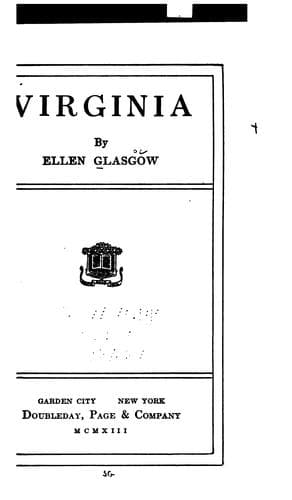
Marriage -- Fiction; Virginia -- Fiction; Wives -- Fiction; Women -- Fiction
A wave of joy rose in her breast, and she felt that her heart melted in
gratitude for the divine beauty of life. The world showed to her as a
place filled with shining vistas of happiness, and at the end of each of
these vistas there awaited the unknown enchanting thing which she called
in her thoughts "the future." The fact that it was the same world in
which Miss Priscilla and her mother lived their narrow and prosaic lives
did not alter by a breath her unshakable conviction that she herself was
predestined for something more wonderful than they had ever dreamed of.
"He may come this evening!" she thought, and immediately the light of
magic suffused the room, the street outside, and every scarred roof in
Dinwiddie.
At the head of her bed, wedged in between the candle stand and the
window, there was a cheap little bookcase of walnut which contained the
only volumes she had ever been permitted to own--the poems of Mrs.
Hemans and of Adelaide Anne Procter, a carefully expurgated edition of
Shakespeare, with an inscription in the rector's handwriting on the
flyleaf; Miss Strickland's "Lives of the Queens of England"; and several
works of fiction belonging to the class which Mrs. Pendleton vaguely
characterized as "sweet stories." Among the more prominent of these
were "Thaddeus of Warsaw," a complete set of Miss Yonge's novels, with a
conspicuously tear-stained volume of "The Heir of Redclyffe," and a
romance or two by obscure but innocuous authors. That any book which
told, however mildly, the truth about life should have entered their
daughter's bedroom would have seemed little short of profanation to both
the rector and Mrs. Pendleton. The sacred shelves of that bookcase
(which had been ceremoniously presented to her on her fourteenth
birthday) had never suffered the contaminating presence of realism. The
solitary purpose of art was, in Mrs. Pendleton's eyes, to be "sweet,"
and she scrupulously judged all literature by its success or failure in
this particular quality. It seemed to her as wholesome to feed her
daughter's growing fancy on an imaginary line of pious heroes, as it
appeared to her moral to screen her from all suspicion of the existence
of immorality. She did not honestly believe that any living man
resembled the "Heir of Redclyffe," any more than she believed that the
path of self-sacrifice leads inevitably to happiness; but there was no
doubt in her mind that she advanced the cause of righteousness when she
taught these sanctified fallacies to Virginia.
As she rose from her knees, Virginia glanced at her white dress, which
was too crumpled for her to wear again before it was smoothed, and
thought regretfully of Aunt Docia's heart, which invariably gave warning
whenever there was extra work to be done. "I shall have to wear either
my blue lawn or my green organdie this evening," she thought. "I wish I
could have the sleeves changed. I wonder if mother could run a tuck in
them?"
Public-domain text, read in full here on John Shaqi.
Reviews
Reviews
No reviews yet
Be the first to share your thoughts on this work.
Join the Discussion
Join the discussion
Sign in to leave a comment or review.
Sign InorCreate an account