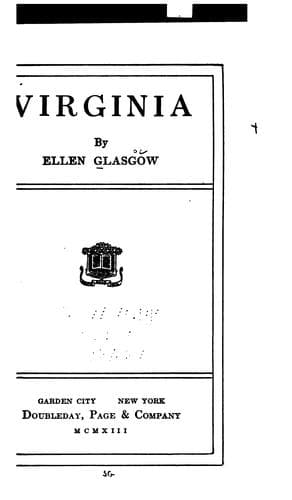
Marriage -- Fiction; Virginia -- Fiction; Wives -- Fiction; Women -- Fiction
She moved on a step or two, while the white pullet was handed over by
its feet to the small coloured urchin and to destruction. If Mrs.
Pendleton had ever reflected on the tragic fate of pullets, she would
probably have concluded that it was "best" for them to be fried and
eaten, or Providence, whose merciful wisdom she never questioned, would
not have permitted it. So, in the old days, she had known where the
slave market stood, without realizing in the least that men and women
were sold there. "Poor things, it does seem dreadful, but I suppose it
is better for them to have a change sometimes," she would doubtless have
reasoned had the horror of the custom ever occurred to her--for her
heart was so sensitive to pain that she could exist at all only by
inventing a world of exquisite fiction around her.
"Aren't you nearly through, mother?" pleaded Virginia at last. "The sun
will be so hot going home that it will make your head worse."
Mrs. Pendleton, who was splitting a pea-shell with her thumb in order to
ascertain the size and quality of the peas, murmured soothingly, "Just a
minute, dear"; and the girl, finding it impossible to share her mother's
enthusiasm for slaughtered animals, fell back again into the narrow
shade of the stalls. She revolted with a feeling of outrage against the
side of life that confronted her--against the dirty floor, strewn with
withered vegetables above which flies swarmed incessantly, and against
the pathos of the small bleeding forms which seemed related neither to
the lamb in the fields nor to the Sunday roast on the table. That divine
gift of evasion, which enabled Mrs. Pendleton to see only the thing she
wanted to see in every occurrence, was but partially developed as yet in
Virginia; and while she stood there in the midst of her unromantic
surroundings, the girl shuddered lest Oliver Treadwell should know that
she had ever waited, hot, perspiring, with a draggled skirt, and a bag
of tomatoes grasped in her hands, while her mother wandered from stall
to stall in a tireless search for peas a few cents cheaper than those of
Mr. Dewlap. Youth, with its ingenuous belief that love dwells in
external circumstances, was protesting against the bland assumption of
age that love creates its own peculiar circumstances out of itself. It
was absurd, she knew, to imagine that her father's affection for her
mother would alter because she haggled over the price of peas; yet the
emotion with which she endowed Oliver Treadwell was so delicate and
elusive that she felt that the sight of a soiled skirt and a perspiring
face would blast it forever. It appeared imperative that he should see
her in white muslin, and she resolved that if it cost Docia her life she
would have the flounces of her dress smoothed before evening. She, who
was by nature almost morbidly sensitive to suffering, became, in the
hands of this new and implacable power, as ruthless as Fate.
Public-domain text, read in full here on John Shaqi.
Reviews
Reviews
No reviews yet
Be the first to share your thoughts on this work.
Join the Discussion
Join the discussion
Sign in to leave a comment or review.
Sign InorCreate an account