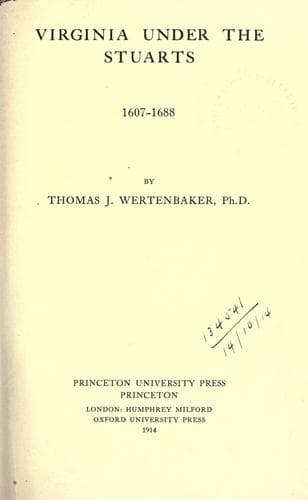
Virginia under the Stuarts 1607-1688Wertenbaker, Thomas Jefferson
History
Virginia under the Stuarts 1607-1688
Wertenbaker, Thomas Jefferson
Virginia -- History -- Colonial period, ca. 1600-1775
Thus were the colonies sacrificed upon the altar of greed. The new act
injured the Virginia planters in several ways. Since all their tobacco
must now be brought to English ports, they could no longer seek the most
advantageous markets. Had the demand for the commodity in England been
more elastic, the consequences of this provision might not have been
disastrous. Declining prices would have so stimulated the demand that
the English could have consumed the entire crop. But the King's customs
kept up the price to the consumer, and made it impossible for the
merchants to dispose of the vast quantities of the leaf that had
formerly gone to Holland and other countries.[384] Moreover, the
varieties sold to the Dutch were not popular in England, and could not
be disposed of at any price. Soon the market became so glutted that the
merchants refused to take more than half the crop, leaving the remainder
to rot upon the hands of the planters.
There followed in Virginia a sharp decline in prices. The Dutch had
given the colonists three pence a pound for their tobacco.[385] A few
years after the Restoration the planters considered themselves fortunate
if they could dispose of their crops at a half penny a pound. Much was
sold at a farthing.[386] Now since tobacco was the staple product of
Virginia and the main support of the people, this rapid decline in its
value was disastrous. Frequent complaints were sent to England that the
colonists could not maintain themselves and their families upon the
meagre returns from their tobacco. "Twelve hundred pounds is the medium
of men's yearly crops," wrote Secretary Ludwell in 1667, "and a half
penny per pound is certainly the full medium of the price given for it."
This made an average income for each planter of but fifty shillings.
When the poor man had paid his taxes for the necessary support of the
government, very little remained to him to clothe his wife and children.
"So much too little," he adds, "that I can attribute it to nothing but
the mercy of God, that he has not fallen into mutiny and
confusion."[387] In 1673 the Governor and the Council declared that the
colony was full of indigent persons, who could barely support themselves
with their utmost exertions.[388]
Not only did the act of 1660 depress the price of tobacco, but it
increased the already excessive freight rates. Since the bulk of the
colonial exports had now to be brought directly to England, in English
ships, the masters of Plymouth or London could double or triple their
charges. Simultaneously there occurred a pronounced rise in the cost of
manufactured goods. The far-famed skill of the Dutch workmen had made it
possible for them to produce many articles more cheaply than the
English, and to underbid them in their own colonies. But now that all
foreign goods were excluded, the planters were forced to purchase the
more expensive product of the English workshops.
Public-domain text, read in full here on John Shaqi.
Reviews
Reviews
No reviews yet
Be the first to share your thoughts on this work.
Elsewhere in the archive
Join the Discussion
Join the discussion
Sign in to leave a comment or review.
Sign InorCreate an account