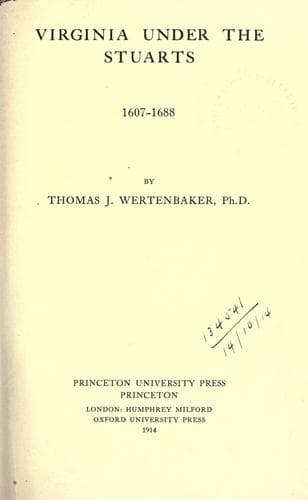
Virginia under the Stuarts 1607-1688Wertenbaker, Thomas Jefferson
History
Virginia under the Stuarts 1607-1688
Wertenbaker, Thomas Jefferson
Virginia -- History -- Colonial period, ca. 1600-1775
Thus were the Virginians cut with a two-edged sword. At the very time
that their incomes were being diminished, they were confronted by an
increase in the cost of living. Nor could they, as Lord Baltimore
declared they might, alleviate these evils by industry and thrift. For
the more strenuous were their efforts to increase the tobacco crop, the
greater would be the glut in the English market and the more disastrous
the drop in prices.
The poor colonists found an able, but an unsuccessful advocate, in a
London merchant named John Bland. "If the Hollanders," he wrote in a
paper addressed to the King, "must not trade to Virginia how shall the
Planters dispose of their Tobacco? The English will not buy it, for what
the Hollander carried thence was a sort of Tobacco, not desired by any
other people, ... the Tobacco will not vend in England, the Hollanders
will not fetch it from England; what must become thereof?" But Charles
II, who knew little of economic matters, and cared nothing for the
welfare of the colonists, ignored Bland's convincing appeal. No
alleviation was given Virginia, and she was allowed to drift on through
poverty and desperation to rebellion.
In a vain attempt to make the colony independent of the English
manufacturers and to turn the people from the excessive planting of
tobacco, the Assembly passed a series of acts designed to encourage
local industrial establishments. It was especially desired that Virginia
should make her own cloth, for the cost of the English fabrics was
excessive.[389] To stimulate the art of spinning and weaving the
Assembly offered rewards for the best pieces of linen and woollen goods
produced in the country. A bounty was placed on the manufacture of
silk.[390] In 1666, the establishment of cloth works in each county was
made compulsory by act of Assembly.[391] "Whereas," it was declared,
"the present obstruction of trade and the nakedness of the country doe
suffitiently evidence the necessity of provideing supply of our wants by
improveing all meanes of raysing and promoteing manufactures amonge
ourselves, ... Be it enacted ... that within two yeares at furthest ...
the commissioners of each county court shall provide and sett up a loome
and weaver in each of the respective counties."[392] Nor were other
industries neglected. Tan-houses were erected in various places "to
tanne, curry and make the hides of the country into leather and
shoes".[393] Bounties were offered for the construction of vessels, in
the hope that Virginia might rival the prosperous ship-builders of New
England.[394]
These experiments added a heavy burden to the poor taxpayer, while they
accomplished little for the relief of the colony. Virginia, with its
scattered plantations and its lack of skilled artisans, could not hope
to compete with the workshops of England. The commissioners, whether
from corruption or from lack of ability, proved poor business managers,
and their ill success occasioned loud and bitter complaints.
Public-domain text, read in full here on John Shaqi.
Reviews
Reviews
No reviews yet
Be the first to share your thoughts on this work.
Elsewhere in the archive
Join the Discussion
Join the discussion
Sign in to leave a comment or review.
Sign InorCreate an account