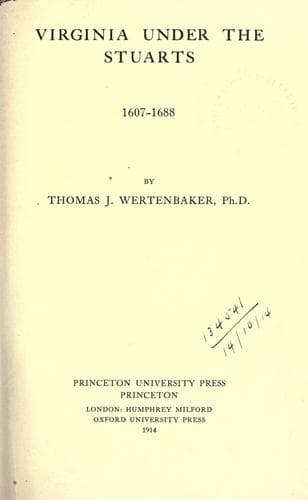
Virginia under the Stuarts 1607-1688Wertenbaker, Thomas Jefferson
History
Virginia under the Stuarts 1607-1688
Wertenbaker, Thomas Jefferson
Virginia -- History -- Colonial period, ca. 1600-1775
Early in June, 1676, Berkeley had written the King, complaining that his
age and infirmities were such that he could no longer perform properly
his office in Virginia, and requesting that he be allowed to retire from
active service.[723] The Council had protested against this resignation,
but Charles thought it best to take Sir William at his word and to
recall him from the government he had not been able to preserve in peace
and quiet. In honor of his long service, and his well known loyalty, he
was, however, to retain "the title and dignity of Governor".[724] He was
ordered to return to England "with all possible speed", to report upon
his administration and to give an account of the extraordinary tumults
in the colony.[725] During his absence the duties of his office were to
be entrusted to Colonel Herbert Jeffreys, who was to bear the title of
Lieutenant-Governor.[726] He was not, however, to be the deputy or
assistant of Sir William, and "to all intents and purposes" was made
Governor-in-chief. Berkeley was to be "no wayes accountable" for his
actions good or bad.[727]
The King instructed Colonel Jeffreys, before attempting to subdue the
rebels by force of arms, to exhaust all peaceable means of securing
their submission. In order to make this task more easy, he drew up and
had printed a proclamation of pardon, which he directed him to publish
throughout the colony. All, it declared, with the sole exception of
Bacon, that should surrender themselves, and take the oath of allegiance
and supremacy, were to receive free and full forgiveness. Charles felt
that most of the colonists were at heart still loyal, and would, if
their grievances were redressed, be glad to accept his royal offer of
grace.
But he did not rely entirely upon gentle measures, for, after all, the
stubborn Virginians might distrust his promises and reject the pardon.
So he resolved to send to the colony a strong body of troops to bring
them to their senses, if necessary, at the point of the bayonet. A
thousand men, thoroughly equipped for active service, were put under the
command of Colonel Jeffreys and embarked for the colony.[728]
In the meanwhile, Governor Berkeley, having regained his authority, was
busily engaged in reimbursing himself and his friends for their losses
in the Rebellion. There can be no doubt that many of the loyalists had
suffered severely by the depredations of the insurgents.[729] Those that
followed the Governor into exile upon the Eastern Shore, had been
compelled to leave their estates to the mercy of the enemy. And the
desperate rebels, especially after death had removed the strong arm of
Bacon, had subjected many plantations to thorough and ruthless pillage.
Crops had been destroyed, cattle driven off, farm houses burned,
servants liberated. Almost every member of the Council had suffered,
while Berkeley himself claimed to have lost no less than £10,000.[730]
Public-domain text, read in full here on John Shaqi.
Reviews
Reviews
No reviews yet
Be the first to share your thoughts on this work.
Elsewhere in the archive
Join the Discussion
Join the discussion
Sign in to leave a comment or review.
Sign InorCreate an account