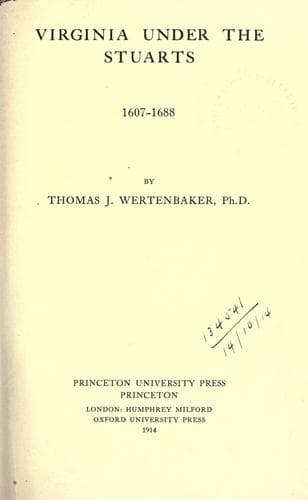
Virginia under the Stuarts 1607-1688Wertenbaker, Thomas Jefferson
History
Virginia under the Stuarts 1607-1688
Wertenbaker, Thomas Jefferson
Virginia -- History -- Colonial period, ca. 1600-1775
Thus, it was with a spirit of bitterness and hatred that the loyalists,
in January and February, returned to their ruined homes. Quite
naturally, they set up a clamor for compensation from the estates of
those that had plundered them. Now that the King's authority had been
restored, and the cause they had contended for had triumphed, they
demanded that the vanquished should be made to disgorge their plunder
and pay for their wanton destruction. Surely the Governor's followers
could not be expected to accept readily all these great losses as a
reward for their loyalty.
But restoration upon a large scale would almost certainly entail
injustice, and would fan again the flames of bitterness and hatred. It
might be possible to restore many articles yet remaining in the hands of
the rebels, but most of the plundered goods had long since been
consumed. It was often impossible to determine what persons had been
guilty of specific acts of pillage, while many of the most active
rebels were very poor men, from whom no adequate compensation could be
obtained.
There ensued an undignified and pernicious scramble by the loyalists to
seize for their own use the property of the few well-to-do insurgents.
On all sides confiscation, unauthorized seizures, and violence marked
the collapse of the Rebellion. In these proceedings Sir William took the
lead. His servants went out, under pretence of searching for his stolen
property, to take for his use the sheep, the cattle, and other goods of
the neighboring rebels.[731] He showed, it was declared, "a greedy
determination thoroughly to heale himselfe before hee car'd to staunch
the bleeding gashes of the woefully lacerated country.... Making and
treating men as delinquents, before any due conviction or attainder, by
seizing their estates, cattle, servants and carrying off their tobacco,
marking hogsheads and calling this securing it to the King's
service."[732]
Even more unjustifiable was the conduct of Sir William in resorting to
arbitrary compositions with his prisoners to fill his exhausted
purse.[733] Men were arrested, thrown into jail, terrified with threats
of hanging, and released only upon resigning to the Governor most or all
of their estates.[734] One James Barrow was locked up at Green Spring
and refused permission to plead his case before the Governor. He was
told that his release could be secured only upon the payment of a
ruinous composition. "By reason," he said, "of the extremity of Cold,
hunger, lothsomnesse of Vermin, and other sad occasions, I was forct to
comply."[735] Edward Loyd was held for twenty-one days, while his
plantation was invaded, and his wife so frightened that she fell into
labor and died.
Public-domain text, read in full here on John Shaqi.
Reviews
Reviews
No reviews yet
Be the first to share your thoughts on this work.
Elsewhere in the archive
Join the Discussion
Join the discussion
Sign in to leave a comment or review.
Sign InorCreate an account