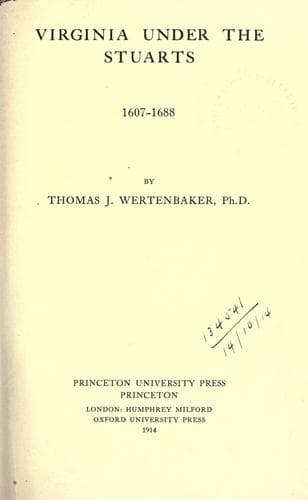
Virginia under the Stuarts 1607-1688Wertenbaker, Thomas Jefferson
History
Virginia under the Stuarts 1607-1688
Wertenbaker, Thomas Jefferson
Virginia -- History -- Colonial period, ca. 1600-1775
But Culpeper, fearful of the King's displeasure, and uneasy for the
payment of his own salary, made strenuous efforts to secure the passage
of the bill. He did not scruple to resort to bribery and intimidation to
force obedience from the stubborn Burgesses. We have the testimony of
the Governor himself to one notorious case of the misuse of the
patronage. Among the leaders of the House of Burgesses was Isaac
Allerton, a man of wealth and education, and an excellent speaker.[902]
"He did assure me," Culpeper reported to the Privy Council, "of his
utmost services in whatsoever the King should command him by his
Governor, particularly as to a further Bill of Revenue for the support
of ye Government, And I did engage to move his Majesty that hee should
bee of the Council ... though not to be declared till after the Session
of next Assembly, when I am sure he can bee as serviceable if not more
than any other person whatsoever."[903] This bargain was faithfully kept
and in time Allerton, for thus betraying his trust, received his seat in
the Council.[904]
Nor did Lord Culpeper hesitate to intimidate the Burgesses by
threatening to demand the payment of all arrears of quit-rents. This
tax, although belonging to the King from the first settlement of the
colony, had not, for many years, been duly collected. It was now
rumored, however, that the Privy Council intended, not only to enforce
for the future a strict payment, but to demand a settlement for the
accumulated arrears. In 1679 Sir Henry Chicheley had forwarded to his
Majesty a petition from the Assembly asking relief from this great
burden. If this be not granted, he wrote, the payments which have been
so long due and amount to so vast a sum, will fall heavily upon all, but
especially upon the poor.[905] Culpeper, knowing well the anxiety of the
Burgesses upon this point, told them that if they expected the King to
grant their petition, they must yield to his desire for a royal revenue
in the colony.
Calling the Assembly before him, he urged them to resume their debate.
"It looks," he said, "as if you could give noe reasons or as if you were
affraid to be convinced.... I desire you to lay aside that irregular
proceeding ... and resume the debate." The Council, he added, had given
their unanimous consent to the bill. "Consider the affaires of the Quitt
Rents, Consider the King's favour in every thing you may aske even to a
cessacon ... and reflect if it be tante for you not to concurr in a
thing that, I am assured, ye King ... judges his owne and will soe use
it and the more fully then if this Act pass."[906]
Public-domain text, read in full here on John Shaqi.
Reviews
Reviews
No reviews yet
Be the first to share your thoughts on this work.
Elsewhere in the archive
Join the Discussion
Join the discussion
Sign in to leave a comment or review.
Sign InorCreate an account