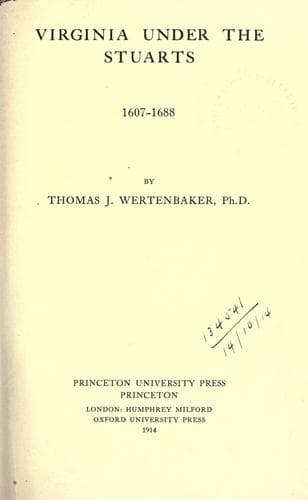
Virginia under the Stuarts 1607-1688Wertenbaker, Thomas Jefferson
History
Virginia under the Stuarts 1607-1688
Wertenbaker, Thomas Jefferson
Virginia -- History -- Colonial period, ca. 1600-1775
Thus threatened, the Burgesses finally yielded, and the bill became law.
But they insisted upon adding to it two provisos: that the former export
duty upon tobacco be repealed, and that the exemption of Virginia ship
owners from the payment of the tax, which had been a provision of the
former law, should be continued.[907] When some months later the matter
came before the Committee of Trade and Plantations, their Lordships
expressed much dissatisfaction at these amendments, declaring that the
bill should have passed "in Terminis". Since, however, the first proviso
in no way changed the sense of the act, and had been added only to
prevent a double imposition, they recommended that it should be
continued. But the second was declared null and void by order of the
King, as "irregular and unfit to be allowed of".[908]
Lord Culpeper, immediately after the dismissal of the Assembly made
ready to return to England. August 3, 1680, he read to the Council an
order from the King granting him permission to leave the colony, and a
few days later he set sail in _The James_.[909] The government was again
left in the hands of the infirm Chicheley.[910]
Culpeper, upon his arrival in England, told the King that all was well
in the colony, that the old contentions had been forgotten, and the
people were happy and prosperous. But this favorable report, which was
made by the Governor to palliate his desertion of his post, was far from
being true. There was, as he well knew, a deep-seated cause of
discontent in Virginia, that threatened constantly to drive the people
again into mutiny and disorder. This was the continued low price of
tobacco. In the years which had elapsed since Bacon's Rebellion, the
people, despite their bitter quarrels, had produced several large crops,
and the English market was again glutted. "What doth quite overwhelm
both us and Maryland," complained the colonists, "is the extreme low
price of our only commodity ... and consequently our vast poverty and
infinite necessity."[911] The Burgesses, in 1682, spoke of the
worthlessness of tobacco as an "ineffable Calamity". "Wee are," they
said, "noe wayes able to force a miserable subsistance from the same....
If force of penne, witt, or words Could truely represent (our condition)
as it is, the sad resentments would force blood from any Christian
Loyall Subjects heart."[912] Some months later the Council wrote, "The
people of Virginia are generally, some few excepted, extremely poor, ...
not being able to provide against the pressing necessities of their
families."[913] That the Privy Council was aware, as early as October,
1681, that these conditions might lead to another insurrection, is
attested by a letter of the Committee of Trade and Plantations to Lord
Culpeper. "We are informed," they wrote, "that Virginia is in great
danger of disturbance ... by reason of the extreme poverty of the
People, occasioned by the low price of tobacco which, tis feared may
Public-domain text, read in full here on John Shaqi.
Reviews
Reviews
No reviews yet
Be the first to share your thoughts on this work.
Elsewhere in the archive
Join the Discussion
Join the discussion
Sign in to leave a comment or review.
Sign InorCreate an account