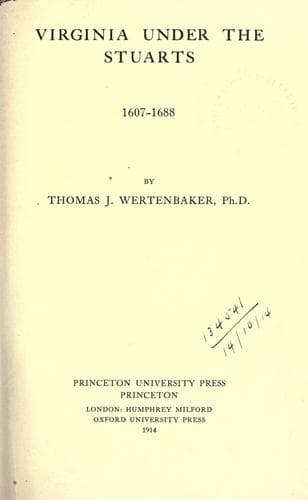
Virginia under the Stuarts 1607-1688Wertenbaker, Thomas Jefferson
History
Virginia under the Stuarts 1607-1688
Wertenbaker, Thomas Jefferson
Virginia -- History -- Colonial period, ca. 1600-1775
So the prosecution was now directed against some of the actual
plant-cutters. In this, however, Culpeper found himself greatly
embarrassed by Chicheley's previous treatment of the matter. The
Deputy-Governor had, some months before, issued pardons to many of the
chief offenders, and had permitted the others to give bail, thus
treating their crime as "Ryot and noe more", and making the affair seem
"as slight as possible to the people".[939] But Culpeper, despite this
action of Sir Henry, ordered the arrest of four of the most notorious
plant-cutters and charged them with high treason. Their trial created
great excitement throughout the colony, but "despite the high words and
threats" of the rabble, three of them were convicted. Two were
executed--Somerset Davies at Jamestown, and Black Austin "before the
Court-house in Glocester county, where the Insurrection first broke
out".[940] The third was pardoned by the Governor. "Hee was extremely
young," Culpeper wrote, "not past 19, meerely drawn in and very
penitent, and therefore ... I thought fit to mingle mercy with Justice
and Repreeved him ... to the end the whole country might be convinced
that there was no other motive in the thing but purely to maintain
Government."[941]
But although Culpeper was thus vigorous in punishing the disorders of
the poor people, he did nothing to remove the cause of their
turbulence--the low price of tobacco. By an order in Council of June 17,
1682, he had been directed to grant a cessation, should it seem
expedient, and had been given a letter from Secretary Jenkins to Lord
Baltimore, requiring the coöperation of Maryland.[942] But, upon
finding the colony in peace and quiet, and the Assembly busy with other
concerns, he "took advantage thereof", and kept secret this unexpected
concession. Culpeper pretended to believe that the desired cessation
would be of no real benefit to the planters, but it is clear that he was
consciously betraying the colony to the greed of the royal
Exchequer.[943] "I soe encouraged the planting of tobacco," he reported
to the Privy Council, "that if the season continue to be favorable ...
there will bee a greater cropp by far than ever grew since its first
seating. And I am confident that Customs next year from thence will be
£50,000 more than ever heretofore in any one year."[944] Immediately
after, he declared that he well knew "that the great Cropp then in hand
would most certainly bring that place into the utmost exigencies
again", and he promised to be prepared to quell the disturbances that
would result.[945]
Public-domain text, read in full here on John Shaqi.
Reviews
Reviews
No reviews yet
Be the first to share your thoughts on this work.
Elsewhere in the archive
Join the Discussion
Join the discussion
Sign in to leave a comment or review.
Sign InorCreate an account