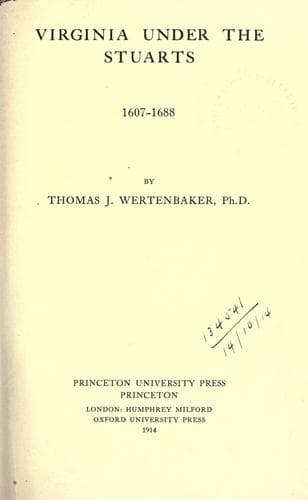
Virginia under the Stuarts 1607-1688Wertenbaker, Thomas Jefferson
History
Virginia under the Stuarts 1607-1688
Wertenbaker, Thomas Jefferson
Virginia -- History -- Colonial period, ca. 1600-1775
Before Lord Culpeper left England an order had been delivered to him
"commanding that noe Governour of his Majesty's Plantations, doe come
into England from his Government", without first obtaining leave from
the King.[946] But so loath was he to remain long in Virginia, that as
soon as he had dispatched the business of the April court, he once more
set sail for England. "I judged it a proper time," he said, "to make a
step home this easy quiet year, not out of any fondness to bee in
England, ... but for the King's service only."[947]
But Charles and the Privy Council were weary of Culpeper's neglect of
duty. They decided to rid themselves of so untrustworthy an officer and
to appoint in his place a man that would remain in the colony and carry
out their wishes and policies. An inquisition was held upon his conduct,
and his letters patent as Governor-General were declared void.[948] On
the 28th of September, 1683, a commission as Lieutenant- and
Governor-General of Virginia was granted to Lord Howard of
Effingham.[949]
Few British colonial Governors are less deserving of respect than Thomas
Lord Culpeper. He was insensible of any obligation to guard the welfare
of the people of Virginia, and was negligent in executing the commands
of the King. He seems to have regarded his office only as an easy means
of securing a large income, and he was untiring in his efforts to extort
money from the exhausted and impoverished colony. Sir William Berkeley's
salary as Governor had been £1,000, but Culpeper demanded and received
no less than £2,000.[950] In addition, he was allowed £150 a year in
lieu of a residence, received pay as captain of infantry and claimed
large sums under the provisions of the Arlington-Culpeper grant.
Nor did he scruple to resort to open fraud in satisfying his greed.
There were, in 1680, two companies remaining in Virginia of the troops
sent over to suppress Bacon's Rebellion. Having received no pay for many
months, the soldiers were discontented and mutinous.[951] The Privy
Council entrusted to Culpeper, upon his first departure for the colony,
money to satisfy them, and to compensate the householders with whom they
had been quartered.[952] At this period, as always in the seventeenth
century, there was a great scarcity of specie in Virginia. But there
circulated, usually by weight, various foreign coins, the most common of
which was the Spanish piece of eight, about equal in value to five
shillings in English money. My Lord, upon his arrival, industriously
bought up all the worn coins he could secure, arbitrarily proclaimed
them legal tender at the ratio of six shillings to one piece of eight,
and then paid the soldiers and the landlords. This ingenious trick
probably netted him over £1,000. Later he restored the ratio to five to
one, so that he would lose nothing when his own salary became due. Of
such stuff were some of the Virginia colonial governors.[953]
Public-domain text, read in full here on John Shaqi.
Reviews
Reviews
No reviews yet
Be the first to share your thoughts on this work.
Elsewhere in the archive
Join the Discussion
Join the discussion
Sign in to leave a comment or review.
Sign InorCreate an account