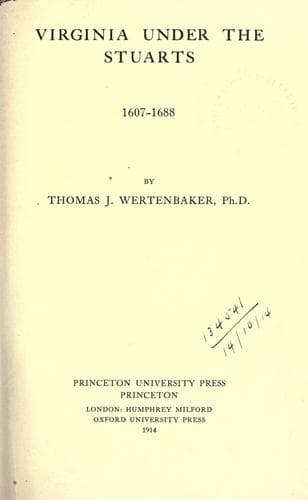
Virginia under the Stuarts 1607-1688Wertenbaker, Thomas Jefferson
History
Virginia under the Stuarts 1607-1688
Wertenbaker, Thomas Jefferson
Virginia -- History -- Colonial period, ca. 1600-1775
This address received scant consideration from the King and the Privy
Council. "Whereas," James II wrote Effingham in October, 1685, "it hath
been represented unto us by our Committee for Trade and Plantations,
that they have received from some unknown persons a paper entitled an
address and supplication of the General Assembly of Virginia ... which
you had refused to recommend as being unfit to be presented.... Wee
cannot but approve of your proceedings.... And wee doe further direct
you to discountenance such undue practices for the future as alsoe the
Contrivers and Promoters thereof."[967] For their activity in this
matter Sherwood and Milner "in ye following year were both turned out of
all imployments to their great damage and disgrace".[968]
In the spring of 1685 Effingham received notification from the Privy
Council of the death of Charles II and the accession of the Duke of York
as James II.[969] He replied a few days later, "I have, with the
greatest solemnity this place is capable of proclaimed his Majesty King
James II in all the considerable places of this colony, where the great
Acclamations and Prayers of the People gave a universal Testimony of
their Obedience."[970] Despite these outward manifestations of joy, the
people were by no means pleased to have a Roman Catholic monarch upon
the English throne. When news reached Virginia that the Duke of Monmouth
was in open rebellion, and had gained important successes over his
Majesty's forces, there was grave danger that the commons of the colony
might espouse his cause.[971] Many were so emboldened, wrote Effingham,
"that their tongues ran at large and demonstrated the wickedness of
their hearts, till I secured some and deterred others from spreading
such false reports by my Proclamation".[972] The defeat and execution
of the Duke of Monmouth for a time ended all thought of resistance to
the King.
But Effingham found the people sullen and discontented and the Burgesses
more stubborn than ever. The session of Assembly of 1685 was, perhaps,
the most stormy ever held in Virginia. The House made a strenuous and
successful resistance to a vigorous attempt to deprive it of its control
over taxation. In 1662, when the Assembly was dominated by Sir William
Berkeley, an act had been passed empowering the Governor and Council to
levy annually for three years a tax of not more than twenty pounds of
tobacco per poll.[973] In 1680 the Council had requested Lord Culpeper
to represent to the King the disadvantages of leaving taxation entirely
in the hands of the Assembly, hoping that his Majesty would by
proclamation revive the law of 1662.[974] The greatest item of expense
to the government, they argued, arose from the Assembly itself, "ye
charge of which hath been too often found to be twice as much as would
have satisfied all publiq dues".[975] The matter was presented to the
consideration of the Burgesses in 1680, but was lost in the committee
room.[976]
Public-domain text, read in full here on John Shaqi.
Reviews
Reviews
No reviews yet
Be the first to share your thoughts on this work.
Elsewhere in the archive
Join the Discussion
Join the discussion
Sign in to leave a comment or review.
Sign InorCreate an account