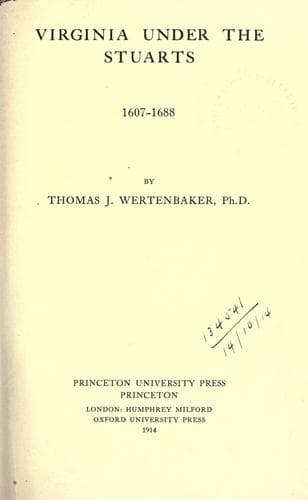
Virginia under the Stuarts 1607-1688Wertenbaker, Thomas Jefferson
History
Virginia under the Stuarts 1607-1688
Wertenbaker, Thomas Jefferson
Virginia -- History -- Colonial period, ca. 1600-1775
But Effingham had no such scruples, and told the Burgesses plainly the
commands he bore from the King.[960] The House, in great dismay,
requested the Governor and the Council to join them in an address to his
Majesty, imploring him to restore a privilege which had so long been
enjoyed "according to ye Laws and antient Practice of the
Country".[961] But Lord Howard replied coldly, "It is what I can in noe
parte admitt of, his Majesty haveing been pleased by his Royal
instruccons to direct & command that noe appeales be open to the General
Assembly."[962]
Nor did the Assembly ever regain this important power. As late as 1691
we find the agent of the Burgesses in England asking in vain for the
restoration of the right of appeals.[963] The change threw into the
hands of the Governor and Council extraordinary power over the judiciary
of the colony. The county justices, who sat in the lower courts, were
the appointees of the Governor, and could not effectually resist his
will. Moreover, as appeals lay from them to the General Court, they were
powerless before the decisions of the superior tribunal. Thus the
judiciary of the colony lost its only democratic feature.
The Burgesses, undismayed by their defeat in this matter, at this same
session entered a vigorous protest against the King's right to annul
acts of Assembly. During Berkeley's administration his Majesty had
seldom exercised this power, but of late many acts had been repealed by
proclamation without the consent or knowledge of the Assembly. This, the
Burgesses claimed, was an unwarranted infringement upon the privileges
granted them "by sundry Comissions, Letters and Instructions", that was
most destructive of their cherished liberties and rights. And they
demanded that henceforth their statutes should have the force of law
until they had been "Repealed by the same Authority of Generall
Assembly".[964] But they received no encouragement from the Governor.
What you ask, he told them, "is soe great an entrenchment upon ye Royall
authority that I cannot but wonder you would offer at it".[965]
Thereupon the House determined to appeal directly to the King,
petitioning him not only to give up the right of repealing laws by
proclamation, but to permit the continuation of appeals to the Assembly.
Since the Governor refused to transmit their address to his Majesty,
they forwarded copies to Secretary Jenkins by two of their own
members--Thomas Milner and William Sherwood.[966]
Public-domain text, read in full here on John Shaqi.
Reviews
Reviews
No reviews yet
Be the first to share your thoughts on this work.
Elsewhere in the archive
Join the Discussion
Join the discussion
Sign in to leave a comment or review.
Sign InorCreate an account