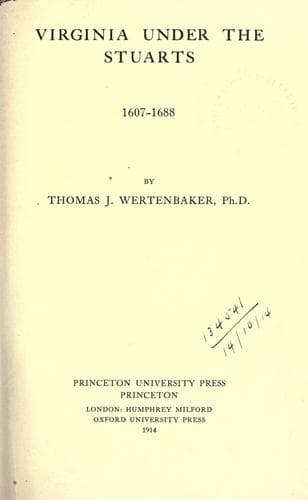
Virginia under the Stuarts 1607-1688Wertenbaker, Thomas Jefferson
History
Virginia under the Stuarts 1607-1688
Wertenbaker, Thomas Jefferson
Virginia -- History -- Colonial period, ca. 1600-1775
alteration or amendment after it was attested by the Clerk of the
General Assembly as assented to, and that it had by that the force of a
Law.... I sent them word again that though any bill was assented to by
mee and the Council, yet if I should afterwards perseive it would prove
prejudicial ... I had power to refuse the signing of it by vertue of His
Majesty's negative voice.... But all would not persuade them out of
their obstinacy, nay tho' I offered to lay that Bill aside till His
Majesty's pleasure should bee known therein; And to sign all the
others.... But nothing would please them but Invading, if not
destroying, His Majesty's Prerogative." The Burgesses declared that they
did not contest the Governor's right to the veto, but contended that
when once he signed a bill, "it could not faile of having ye force of a
Law".[993] Effingham, they complained, was claiming a "double negative
Voice". So angry did they become that they refused to apportion the levy
for defraying the public charges, and after many days of bitter
contention the Governor was forced to prorogue them.
"I did not disolve them," he wrote the Privy Council, "for these
reasons. Because if his Majesty shall think fitt to have them dissolved,
it will bee soe great a rebuke to them, when done by his Majesty's
special command, that I hope it will deter them for the future to bee
soe obstinate and peevish."[994] Accordingly, in August, 1686, the King
wrote the Governor, "Whereas, we have been informed of ye irregular and
tumultuous proceedings of the House of Burgesses of Virginia, at their
late meeting, the members thereof having ... presumed so far as to raise
contests touching ye power of ye Negative Voice ... which wee cannot
attribute to any other Cause then the disaffected & unquiet Dispositions
of those Members.... Wee have thought fitt hereby as a mark of our
displeasure ... to Charge ... you forthwith to Dissolve the present
Assembly."[995]
When this order reached Virginia the Assembly was again in session.
"After I had passed the Acts," wrote Effingham, "I ordered His Majesty's
Letter to bee publickly read to them, and then Dissolved them ... and
told them they were the first Assembly which had been soe dissolved and
I hoped they would bee the last that should deserve it. I ordered copies
of his Majesty's Letter to bee sent to the several County-Courts, that
all the Inhabitants might know how displeasing such proceedings were to
his Majesty."[996] "And now," he added, "the public debts being paid,...
I shall not for the future have soe frequent Assemblys."[997]
Public-domain text, read in full here on John Shaqi.
Reviews
Reviews
No reviews yet
Be the first to share your thoughts on this work.
Elsewhere in the archive
Join the Discussion
Join the discussion
Sign in to leave a comment or review.
Sign InorCreate an account