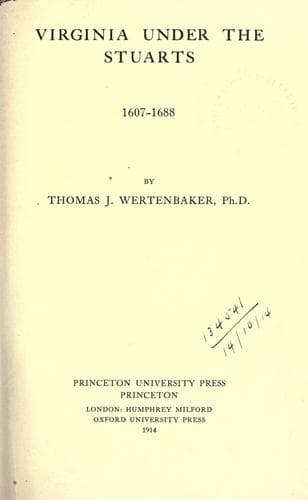
Virginia under the Stuarts 1607-1688Wertenbaker, Thomas Jefferson
History
Virginia under the Stuarts 1607-1688
Wertenbaker, Thomas Jefferson
Virginia -- History -- Colonial period, ca. 1600-1775
More damaging to the Burgesses than this rebuke was the loss of the
right to elect their own clerk. "I was severely angry with their Clerk,"
declared Effingham, "that he durst omit ye least clause, especially soe
material an one ... I sent to the Assembly to make him an example for
it, But they rather maintained him."[998] Some months later the King
sent orders that Beverley be tried for defacing the records and that he
be once more deprived of all offices. Probably because of his great
popularity, Beverley was never brought to trial, but he was forced to
relinquish his lucrative governmental posts.[999] In May, 1686, Nicholas
Spencer wrote the Committee of Trade and Plantations, advocating the
appointment of the clerk by the Governor. "I ... beg leave to present,"
he said, "how necessary it is ... that the clerk of the House ... bee
commissionated by his Majesty's Governour ... and that his salary be
appointed unto him out of his Majesty's revenue. This will take off his
dependency on his great masters the House of Burgesses, and leave noe
room for designed omissions."[1000] Nothing loath, the King, in August,
1686, wrote Lord Howard, "Wee ... require you ... upon the Convening of
the Assembly to appoint a fit person to execute the Office of Clerk of
the House of Burgesses, & not to permit upon any pretense whatsoever any
other person to execute ye said Office but such as shall bee soe chosen
by you."[1001]
Accordingly, at the session of April, 1688, the Governor, with the
approbation of the Council, appointed Captain Francis Page as clerk of
the House.[1002] The Burgesses could but yield, but they told Effingham
that the clerk was still their servant and ought to take the usual oath
of secrecy. "I do declare," replied the Governor, "it was never my
intention nor my desire that the Clerk should be as a spy upon your
Actions and to declare to me your private Debates." It was therefore
agreed that he should take the following oath: "You shall keep secret
all private Debates of the said House of Burgesses."[1003] Despite this,
it was quite evident that the House was no longer to be master of its
own clerk, and that he was to be in the future, to some extent at least,
an emissary of the enemy seated in their midst.
Public-domain text, read in full here on John Shaqi.
Reviews
Reviews
No reviews yet
Be the first to share your thoughts on this work.
Elsewhere in the archive
Join the Discussion
Join the discussion
Sign in to leave a comment or review.
Sign InorCreate an account