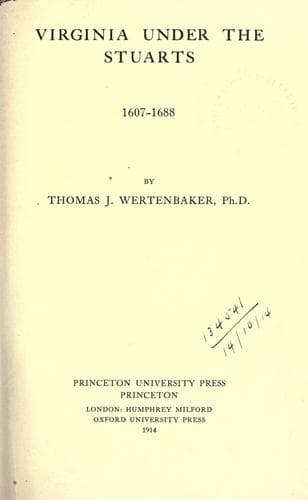
Virginia under the Stuarts 1607-1688Wertenbaker, Thomas Jefferson
History
Virginia under the Stuarts 1607-1688
Wertenbaker, Thomas Jefferson
Virginia -- History -- Colonial period, ca. 1600-1775
One is inclined to ask, when considering the incessant quarrels of the
Governor and the Burgesses, why Lord Howard was less successful than
Governor Berkeley had been in gaining an ascendency over the Assembly.
During the Restoration Period the Burgesses had worked in entire harmony
with Sir William, even when he advocated the oppressive measures that
were so instrumental in bringing on Bacon's Rebellion. Effingham, on the
other hand, found himself continually embroiled with the Assemblymen,
and unable to force them into submission even with rebukes and
persecution.
The explanation must be sought partly in the different characters of the
two Governors. Berkeley was an abler man than Lord Howard, more tactful,
more capable of utilizing the weapons at hand. His method of
overwhelming the legislators with favors was more effective in winning
their support than intimidation and threats. Moreover, Sir William,
himself a Virginian by his long residence in the colony, carried out
only his own policies, and by methods that did not openly assail the
charter rights of the people. Effingham, on the other hand, was the
instrument of the English King and his Councillors in an assault upon
representative government in the colony. It was but natural that all
classes, even the wealthy planters, should resist him with stubborn
resolution. Nor was it possible for Effingham to control, as Sir William
had done, the elections of Burgesses. The opposition of many sheriffs,
whose duty it was to preside at the polls, to the administration, the
greater vigilance of the House, and the independent spirit of the
commons conspired to render the returns more accurate and the House more
responsive to the will of the people. Finally, the poor planters found
now, what they had lacked during the Restoration Period, cultured and
able men to represent them in the Assembly. Without the aggressive
leadership of Major Robert Beverley, Thomas Milner, Colonel Ballard, and
other prominent planters, the cause of the people might have been lost.
Even in the Council the commons had one staunch friend--Colonel Philip
Ludwell. This restless man, who was unable to work in harmony with any
Governor save Sir William Berkeley, sympathized with his old friends of
the Green Spring faction in their resistance to Effingham. As early as
1684 he had aroused the Governor's suspicion by arguing in Council "for
the undutiful Address which was sent to his Majesty",[1009] and during
the sessions of 1685 and 1686 it was thought that he was "an Instrument
in Abbetting and formenting those Disputes & Exceptions the Assembly soe
insisted on".[1010]
Public-domain text, read in full here on John Shaqi.
Reviews
Reviews
No reviews yet
Be the first to share your thoughts on this work.
Elsewhere in the archive
Join the Discussion
Join the discussion
Sign in to leave a comment or review.
Sign InorCreate an account