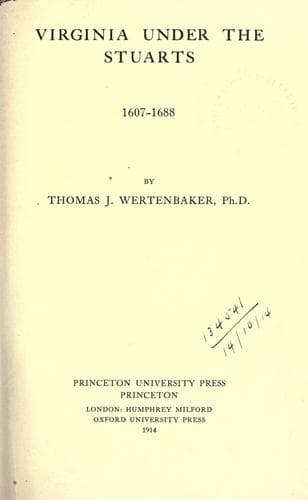
Virginia under the Stuarts 1607-1688Wertenbaker, Thomas Jefferson
History
Virginia under the Stuarts 1607-1688
Wertenbaker, Thomas Jefferson
Virginia -- History -- Colonial period, ca. 1600-1775
The resolute and vigilant defense of the constitutional rights of
Virginia made by the House in this the critical period of her history is
deserving of the highest praise, because it was made in the face of
vigorous personal attacks by Effingham upon the most active of the
members. Every Burgess that voted against the measures proposed by the
King or advocated by his Governor, exposed himself not only to removal
from office, but to active persecution. As we have seen, Mr. William
Sherwood and Colonel Thomas Milner, for forwarding to the Privy Council
the address of the Burgesses in 1684, had been dismissed from
office.[1004] "In ye year 1686 Mr. Arthur Allen & Mr. John Smith, who
were Burgesses in ye year 1685, were turned out of all imployment Civill
& Military to Mr. Allen's great damage, he being a surveyor of land at
that tyme."[1005] I have displaced Allen, wrote Effingham, because he
was "a great promoter of those differences between mee and the Assembly
concerning the King's negative Voice ... as not thinking it fitt that
those who are peevishly opposite to his Majesty's interest should have
any advantage by his favor".[1006] "In the year 1688 Mr. William
Anderson, a member of ye Assembly in that year was soon after the
Assembly by the Governor's order and Command put in ye Common goale and
there detained 7 months, without Tryal, though often prayed for, and
several courts past in ye time of his imprisonment. Nor could he obtain
ye benefit of habeas corpus upon his humble petition.... Mr. Charles
Scarburgh, a member of that Assembly, alsoe was, soon after ye Assembly,
turned out of all imployment and as a mark of his Lordship's
displeasure, a command was sent to ye clerk of ye county to raze his
name out of ye records as a Justice of Peace."[1007] "From whence," it
was declared, "the people conclude these severities are inflicted rather
as a terrour to others than for any personall crimes of their owne, and
is of such ruinous consequence that either the public or particular
interests must fall, for if none oppose, the country must languish under
the severity of the government, or fly into a mutiny to save themselves
from starving. If any do appear more zealous in prosecuting the
countries complaints they know what to expect. It being observable that
none has been thus punisht but those who were forward in the assembly to
oppose the encroachments on the people, and promote the complaint to
England, being out of hope of relief on the place."[1008]
Public-domain text, read in full here on John Shaqi.
Reviews
Reviews
No reviews yet
Be the first to share your thoughts on this work.
Elsewhere in the archive
Join the Discussion
Join the discussion
Sign in to leave a comment or review.
Sign InorCreate an account