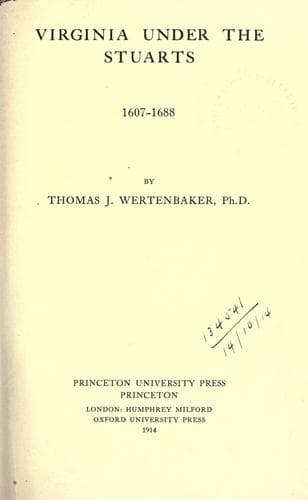
Virginia under the Stuarts 1607-1688Wertenbaker, Thomas Jefferson
History
Virginia under the Stuarts 1607-1688
Wertenbaker, Thomas Jefferson
Virginia -- History -- Colonial period, ca. 1600-1775
The Glorious Revolution was a victory for liberty even more important to
Virginia than to England. It brought to an end those attacks of the
English government upon the representative institutions of the colony
that had marked the past ten years. It confirmed to the people the
rights that had been guaranteed them, through a long series of patents
dating back as far as 1606, and rendered impossible for all time the
illegal oppressions of such men as Harvey, Berkeley, Culpeper and
Effingham. Other Governors of despotic disposition were yet to rule
Virginia--Nicholson, Andros, Dunmore--but it was impossible for them to
resort to the tyrannical methods of some of their predecessors. The
English Revolution had weakened permanently the control of the British
government over the colony, and consequently the power of the Governor.
The advance of liberalism which was so greatly accelerated both in
England and in America by the events of 1688 was halted in the mother
country in the middle of the eighteenth century. But Virginia and the
other colonies were not greatly affected by the reaction upon the other
side of the Atlantic. Here the power of the people grew apace,
encountering no serious check, until it came into conflict with the
sullen Toryism of George III. Then it was that England sought to stifle
the liberalism of the colonies, and revolution and independence
resulted.
The changed attitude of the Privy Council towards Virginia was made
immediately apparent by the careful consideration given the petition of
the Burgesses. Had James remained upon the throne it is probable that
it, like the address of 1684, would have been treated with neglect and
scorn. But William received Ludwell graciously, listened to his plea "on
behalf of the Commons of Virginia", and directed the Committee of Trade
and Plantations to investigate the matter and to see justice done.[1030]
Effingham, who had been called to England upon private business,
appeared before the Committee to defend his administration and to refute
Ludwell's charges. Despite his efforts, several articles of the petition
were decided against him, and the most pressing grievances of the people
redressed. The "Complaint touching the fee of 200lbs of tobacco and
cask", it was reported, "imposed by my Lord Howard for affixing the
Great Seal to Patents ... in regard it was not regularly imposed ... the
committee agree to move his Majesty the same be discontinued".[1031]
Similarly their Lordships declared in favor of abolishing the fee of
thirty pounds of tobacco required for registering surveys. The article
touching the revival of repealed laws by proclamation was referred to
the consideration of the Attorney-General and the Solicitor-General.
These officers gave it as their opinion that his Majesty did have the
right, by repealing acts of repeal, to revive laws, but the committee
agreed to move the King that the Act of Attorneys should be made void by
proclamation.[1032]
Public-domain text, read in full here on John Shaqi.
Reviews
Reviews
No reviews yet
Be the first to share your thoughts on this work.
Elsewhere in the archive
Join the Discussion
Join the discussion
Sign in to leave a comment or review.
Sign InorCreate an account