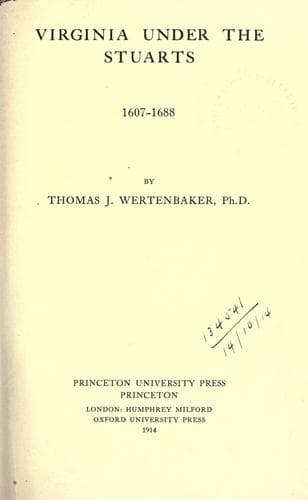
Virginia under the Stuarts 1607-1688Wertenbaker, Thomas Jefferson
History
Virginia under the Stuarts 1607-1688
Wertenbaker, Thomas Jefferson
Virginia -- History -- Colonial period, ca. 1600-1775
This was a signal victory for the Burgesses, but Ludwell, who had
personal scores to settle with the Governor, did not let matters drop
here. After the lapse of several months he appeared once more before the
Committee with charges against Effingham of misgovernment and
oppression.[1033] Referring to the quarrel over the Bill of Ports, in
1685, he accused him of exercising "two negative voices". He complained
bitterly of his attacks upon those Burgesses that had opposed him in the
Assembly, and of his abuse of the power of suspending Councillors. The
money arising from fort duties, he said, which had formerly been
accounted for to the Assembly, had, during Effingham's administration,
"been diverted to other uses". The Governor had established new courts
of judicature contrary to the wishes of the people.
These persistent attacks of Ludwell resulted in another victory, for the
Committee decided that Effingham should no longer rule the colony. He
was not displaced as Governor-General, but he was commanded to remain in
England, and to leave the control of the administration to a
Lieutenant-Governor. This, doubtless, was not unsatisfactory to Lord
Howard, for he retained a part of his salary and was relieved of all the
work and responsibility of his office. The Lieutenant-Governorship was
given to Captain Francis Nicholson.[1034]
Thus the colony emerged triumphant from the Critical Period. It is true
the House of Burgesses had lost many privileges--the right to elect its
own clerk, the right to receive judicial appeals, the right to control
all revenues,--but they had retained within their grasp that
all-important power--the levying of general taxes. And they had gained
greatly in political experience. Long years of watchfulness, of
resistance to encroachments upon their rights, had moulded them into a
body that the most cunning executive could neither cajole nor
intimidate. Unmindful of the anger of Governors, the rebukes of Kings,
of personal loss, even of imprisonment, they had upheld the people's
rights. And their descendants were to reap the reward of their
faithfulness. The traditions of ability, probity and heroism established
by the men of the Critical Period made possible that long and honorable
career of the House of Burgesses and the important rôle it was to play
in winning independence for America.
FOOTNOTES:
[882] Osg., Vol. III, pp. 280, 281.
[883] P. R. O., CO5-1355-334; McD., Vol. V, p. 302.
[884] P. R. O., CO5-1355-313, 334.
[885] P. R. O., CO5-1355-334; McD., Vol. V, p. 302.
[886] P. R. O., CO5-1356; CO391.2-276, 325, 283 to 285.
[887] P. R. O., CO1-43-165.
[888] Hen., II, p. 133.
[889] P. R. O., CO5-1376; Hen., Vol. II, p. 466.
[890] P. R. O., CO5-1355-372.
[891] P. R. O., CO5-1355-375.
[892] P. R. O., CO5-1355-375, 376.
[893] P. R. O., CO5-1355-378.
[894] P. R. O., CO5-1355-385.
[895] P. R. O., CO5-1355-384.
[896] P. R. O., CO5-1376-265.
[897] Jour. H. of B., 1680, p. 1.
[898] Jour. H. of B., 1680, p. 7.
Public-domain text, read in full here on John Shaqi.
Reviews
Reviews
No reviews yet
Be the first to share your thoughts on this work.
Elsewhere in the archive
Join the Discussion
Join the discussion
Sign in to leave a comment or review.
Sign InorCreate an account