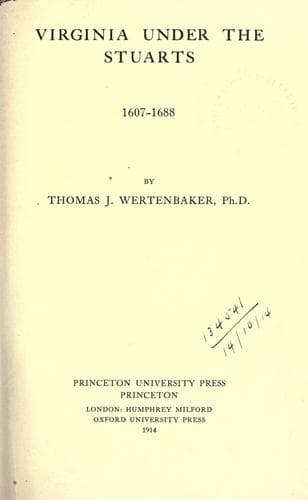
Virginia under the Stuarts 1607-1688Wertenbaker, Thomas Jefferson
History
Virginia under the Stuarts 1607-1688
Wertenbaker, Thomas Jefferson
Virginia -- History -- Colonial period, ca. 1600-1775
Under the provisions of the charter of 1606 Virginia had been, in all
but form, a royal colony. The King had drawn up the constitution, had
appointed the Council in England, and had controlled their policies.
This charter had granted no semblance of self-government to the
settlers. But it was declared "They shall have and enjoy all the
liberties, franchises, and immunities ... to all intents and purposes,
as if they had been abiding and born, within ... this realm of
England".[135] This promise was not kept by the Kings of England.
Several of the provisions of the charter itself were not consistent with
it. In later years it was disregarded again and again by the royal
commissions and instructions. Yet it was of the utmost importance, for
it set a goal which the colonists were determined to attain. Throughout
the entire colonial period they contended for all the rights of native
Englishmen, and it was the denial of their claim that caused them to
revolt from the mother country and make good their independence.
Provision had also been made for trial by jury. James had decreed that
in all cases the Council should sit as a court, but in matters of
"tumults, rebellion, conspiracies, mutiny, and seditions ... murther,
manslaughter", and other crimes punishable with death, guilt or
innocence was to be determined by a jury of twelve. To what extent the
Council made use of the jury system it is impossible to say, but
Wingfield states that on one occasion he was tried before a jury for
slander, and fined £300.[136]
The second charter had been granted in 1609. This document is of great
importance because through it the King resigned the actual control of
the colony into the hands of the Virginia Company. And although this did
not result immediately in the establishment of representative
government, it strengthened the hands of Sandys and made it possible for
him to carry out his designs at a future date. Under this charter the
Company might have set up liberal institutions at once in Virginia, but
conditions were not ripe, either in England or in America, for so
radical a change.
In 1612 the third charter had been granted. This had still further
strengthened the Company and made them more independent of the King. It
gave them the important privilege of holding great quarterly meetings or
assemblies, where all matters relating to the government of the colony
could be openly discussed. Still Virginia remained under the autocratic
rule of Dale and Gates.
Public-domain text, read in full here on John Shaqi.
Reviews
Reviews
No reviews yet
Be the first to share your thoughts on this work.
Join the Discussion
Join the discussion
Sign in to leave a comment or review.
Sign InorCreate an account