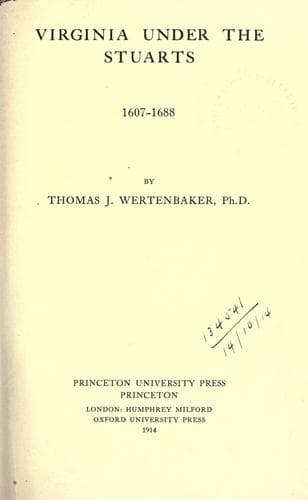
Virginia under the Stuarts 1607-1688Wertenbaker, Thomas Jefferson
History
Virginia under the Stuarts 1607-1688
Wertenbaker, Thomas Jefferson
Virginia -- History -- Colonial period, ca. 1600-1775
The new Governor soon showed that he had no intention of persecuting
Harvey's enemies, or of continuing the bitter quarrels of the preceding
administrations. In his first Council we find Samuel Matthews, William
Pierce and George Minifie, all of whom had been implicated in the
"thrusting out".[315] Whether proceeding under directions from the
English government, or actuated by a desire to rule legally and justly,
he conferred a priceless blessing upon the colony by refusing to use the
judiciary for political persecution. So far as we can tell there was no
case, during his first administration, in which the courts were
prostituted to personal or party ends. Thomas Ludwell afterwards
declared that it was a convincing evidence of Berkeley's prudence and
justice that after the surrender to the Commonwealth, when his enemies
might easily have hounded him to his ruin, "there was not one man that
either publickly or privately charged him with injustice".[316] In
March, 1643, he affixed his signature to a law allowing appeals from the
Quarter Courts to the Assembly. This right, which seems not to have been
acknowledged by Sir John Harvey, was of the very highest importance. It
gave to the middle class a share in the administration of justice and
afforded an effectual check upon the abuse of the courts by the Governor
and Council.
Berkeley greatly endeared himself to the poor planters by securing the
abolition of a poll tax that contributed to the payment of his own
salary.[317] "This," the Assembly declared, "is a benefit descending
unto us and our posterity which we acknowledge contributed to us by our
present Governor."[318] Berkeley also made an earnest effort to relieve
the burden of the poor by substituting for the levy upon tithables
"assessments proportioning in some measure payments according to mens
abilities and estates" But the colonial legislators soon found a just
distribution of the taxes a matter of great difficulty, and we are told
that the new measures, "through the strangeness thereof could not but
require much time of controverting and debating".[319] In 1648 the
experiment was abandoned and the old oppressive tax upon tithables
revived.[320]
During the first administration of Berkeley numerous other measures were
adopted tending to augment the liberty and prosperity of the people. In
1643 a law was passed prohibiting the Governor and Council from imposing
taxes without the consent of the Assembly.[321] At the same session
Berkeley assented to a statute exempting the Burgesses from arrest
during sessions of Assembly and for ten days after dissolution.[322] The
fees of the Secretary of State were limited and fixed in order to
prevent excessive and unjust charges by that officer.[323]
Public-domain text, read in full here on John Shaqi.
Reviews
Reviews
No reviews yet
Be the first to share your thoughts on this work.
Elsewhere in the archive
Join the Discussion
Join the discussion
Sign in to leave a comment or review.
Sign InorCreate an account