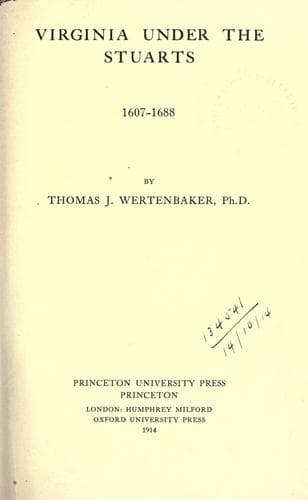
Virginia under the Stuarts 1607-1688Wertenbaker, Thomas Jefferson
History
Virginia under the Stuarts 1607-1688
Wertenbaker, Thomas Jefferson
Virginia -- History -- Colonial period, ca. 1600-1775
That the colonists were not insensible of the Governor's liberal conduct
is shown by their generosity to him on more than one occasion. In 1642
they presented him with an "orchard with two houses belonging to the
collony ... as a free and voluntary gift in consideration of many worthy
favours manifested towards the collony".[324] In 1643, when the war in
England caused the suspension of Berkeley's pensions and allowances from
the King, the Assembly voted a tax of two shillings per poll on all
tithable persons as a temporary relief.[325]
When Sir William assumed the government in 1642 he was conscious that an
effort was being made in England to restore the old London Company of
Virginia, and it became his first care to thwart this design. In 1639
George Sandys had been sent to England as the agent of the Assembly and
had presented a petition in the name of the Virginia planters, to the
House of Commons, for the restoration of the old corporation.[326] The
Assembly of April, 1642, called together by Berkeley, repudiated
entirely the action of their agent, declaring that he had misunderstood
his instructions. The renewal of the Company, they said, was never
"desired, sought after or endeavoured to be sought for either directly
or indirectly by the consent of any Grand Assembly or the common consent
of the people". They drew up a petition to the King, expressing their
desire to remain under his immediate care and protection, citing the
many blessings of the present order of government, and drawing the most
melancholy picture of their sufferings before the revocation of the
charter. "The present happiness," they said, "is exemplified to us by
the freedom of yearly assemblies warranted unto us by his majesties
gratious instructions, and the legal trial per juries in all criminal
and civil causes where it shall be demanded."[327]
This declaration of loyalty and contentment, reaching Charles at a time
when so many of his subjects were rising in rebellion against his
authority, was most pleasing to the unfortunate monarch. "Your
acknowledgement," he replied to the Governor and the Assembly, "of our
grace, bounty, and favour, towards you, and your so earnest desire to
continue under our immediate protection, is very acceptable to us."
"And," he continued, "as we had not before the least intention to
consent to the introduction of any company over that our Colony, we are
by it much confirmed in our resolution, as thinking it unfit to change a
form of government wherein our subjects there ... receive much
contentment and satisfaction".[328]
Public-domain text, read in full here on John Shaqi.
Reviews
Reviews
No reviews yet
Be the first to share your thoughts on this work.
Elsewhere in the archive
Join the Discussion
Join the discussion
Sign in to leave a comment or review.
Sign InorCreate an account