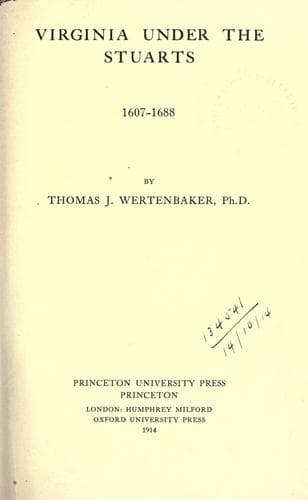
Virginia under the Stuarts 1607-1688Wertenbaker, Thomas Jefferson
History
Virginia under the Stuarts 1607-1688
Wertenbaker, Thomas Jefferson
Virginia -- History -- Colonial period, ca. 1600-1775
The charter that James I granted to the London Company served as a
constitution for Virginia, for it prescribed the form of government and
made regulations that none could disregard. It provided for a Council,
resident in England, to which was assigned the management of the colony
and the supervision of its government.[4] This body was appointed by the
King and was strictly answerable to him through the Privy Council for
its every act.[5] The immediate government of the colony was entrusted
to a local Council, selected by the Council in England, and responsible
to it. The Virginia Council exercised extraordinary powers, assuming all
administrative, legislative and judicial functions, and being in no way
restrained by the wishes or demands of their fellow colonists.[6]
Although they were restricted by the charter and by the instructions of
the Council in England, the isolation of the settlement and the
turbulent spirit of the adventurers made them reckless in enforcing
their own will upon the colonists. More than once they were guilty of
unpardonable harshness and cruelty.
The charter did not provide for the appointment of a Governor. The
nominal leadership of the colony was entrusted to a President, chosen by
the local Council from among its members. This officer had no duty
distinct from that of the Councillors, other than to preside at their
meetings and to cast a double or deciding vote in case of deadlock.[7]
He was to serve but one year and if at any time his administration
proved unsatisfactory to his colleagues, they could, by a majority vote,
depose him. In like manner, any Councillor that had become obnoxious
could be expelled without specific charges and without trial.[8] These
unwise provisions led naturally to disorder and strife, and added much
to the misfortunes of the infant colony.[9]
The selections for the Council were made some days before the fleet
sailed, but the Company, fearing a conflict of authority during the
voyage, thought it best that they should be kept secret until the
colonists had reached Virginia. The names of the appointees were
embodied in "several instruments" which were entrusted to the commanders
of the vessels, with instructions that they should be opened within
twenty-four hours after they had arrived off the coast of America.[10]
Upon entering the Chesapeake Bay the adventurers read the papers, and
found that Christopher Newport, the commander of the fleet, Edward
Wingfield, Bartholomew Gosnold, George Kendall, John Ratcliffe, John
Martin and John Smith were those that had been chosen.[11]
After the landing the Council met, were sworn to office, and then
elected Wingfield President.[12] Captain John Smith, who had been
accused of mutiny during the voyage, was not allowed to take his seat,
and was kept under restraint until the twentieth of June.[13]
Public-domain text, read in full here on John Shaqi.
Reviews
Reviews
No reviews yet
Be the first to share your thoughts on this work.
Join the Discussion
Join the discussion
Sign in to leave a comment or review.
Sign InorCreate an account