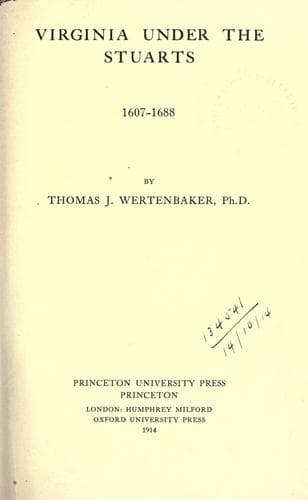
Virginia under the Stuarts 1607-1688Wertenbaker, Thomas Jefferson
History
Virginia under the Stuarts 1607-1688
Wertenbaker, Thomas Jefferson
Virginia -- History -- Colonial period, ca. 1600-1775
Another deadly war with the savages ensued immediately. Sir William
Berkeley several times placed himself at the head of large expeditions
and carried fire and destruction to many Indian villages.[333] As in the
former war, the naked and poorly armed natives could not withstand the
English, and, deserting their homes, they usually fled into the woods at
their approach. And again the white men brought famine upon them by
going out each year in the months of July and August to cut down their
growing maize.[334] In order to protect the isolated frontier
plantations the Governor ordered the people to draw together in
fortified camps, strong enough to resist the assaults of a large body of
the savages.[335] "He strengthened the weak Families," it was said, "by
joining two or three ... together and Palizaded the houses about."[336]
Despite these wise measures the savages would probably have continued
the war many years had not Opechancanough fallen into the hands of the
English. The old king was surprised by Sir William Berkeley, and,
because of his decrepitude, was easily captured.[337] He was taken in
triumph to Jamestown, where the Governor intended to keep him until he
could be sent to England and brought before Charles I. But a few days
after the capture, a common soldier, in revenge for the harm done the
colony by Opechancanough, shot the aged and helpless prisoner in the
back.[338]
Soon after this event the Indians sued for peace. Discouraged and
starving, they promised to become the friends and allies of the whites
forever, if they would cease their hostility and grant them their
protection. A treaty was drawn up and ratified by the Assembly and by
the new Indian king Necotowance.[339] It provided that the savages
should acknowledge the King of England as their sovereign and overlord;
that Necotowance and his successors should pay as tribute "the number of
twenty beaver skins at the goeing of the Geese yearly"; that all the
land between the York and the James from the falls of both rivers to
Kecoughtan should be ceded to the English; that all white prisoners and
escaped negroes should be returned. In compensation the English agreed
to protect the savages from the attacks of their enemies and to resign
to them as their hunting ground the territory north of the York
River.[340] This peace, which was most beneficial to the colony, was not
broken until 1676, when the incursions of the wild Susquehannocks
involved the native Virginia tribes in a new conflict with the white
men.[341]
Public-domain text, read in full here on John Shaqi.
Reviews
Reviews
No reviews yet
Be the first to share your thoughts on this work.
Elsewhere in the archive
Join the Discussion
Join the discussion
Sign in to leave a comment or review.
Sign InorCreate an account