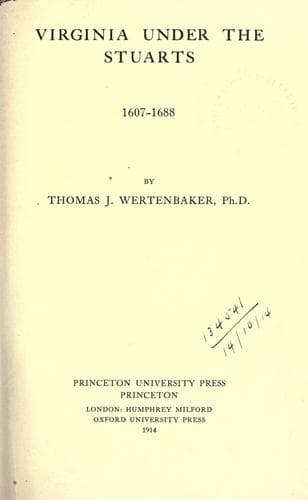
Virginia under the Stuarts 1607-1688Wertenbaker, Thomas Jefferson
History
Virginia under the Stuarts 1607-1688
Wertenbaker, Thomas Jefferson
Virginia -- History -- Colonial period, ca. 1600-1775
In the early years of Berkeley's administration the colony experienced
another horrible Indian massacre. As in 1622 the blow came without
warning. The cruel and barbarous war that followed the first massacre
had long since come to an end and for many years there had been peace
between the two races. It is true that the friendly relations that
resulted from the marriage of Rolfe and Pocahontas had not been
restored, that the Indians were not allowed to frequent the English
settlements, that no weapons were sold them, but the peace was fairly
well observed and there was no reason to suspect the savages of
treachery.
The plot originated in the brain of Opechancanough. This remarkable
savage was long supposed to have been the brother of Powhatan, but newly
discovered evidence tends to show that this was not the case. It is
known that he belonged to a foreign tribe that came from the far
southwest. Having, it is supposed, been defeated in a battle with the
Spaniards, he had led his people to Virginia and united them with the
tribes under the command of Powhatan. This tremendous march must have
consumed many months, and have been beset with countless dangers, but
Opechancanough overcame them, and "conquered all along from Mexico" to
Virginia.[329] He was now an extremely aged man. Being unable to walk he
was carried from place to place upon a litter. His eyelids were so heavy
that he could not of his own volition move them, and attendants stood
always ready to raise them whenever it became necessary for him to
see.[330] But his mind was clear, his force of will unshaken, and the
Indians paid him the reverent obedience that his able leadership
demanded.
Opechancanough planned the massacre for April 18th, 1644, and it was
carried out upon that date with the utmost ferocity.[331] The slaughter
was even greater than in 1622, and no less than five hundred Christians
are said to have been destroyed.[332] But this calamity fell almost
entirely upon the frontier counties at the heads of the great rivers,
and upon the plantations on the south side of the James. The savages
could not penetrate to the older and more populous communities of the
lower peninsula. For this reason the disaster, horrible as it was, did
not overwhelm the entire colony and threaten its destruction as had the
massacre of 1622.
Public-domain text, read in full here on John Shaqi.
Reviews
Reviews
No reviews yet
Be the first to share your thoughts on this work.
Elsewhere in the archive
Join the Discussion
Join the discussion
Sign in to leave a comment or review.
Sign InorCreate an account