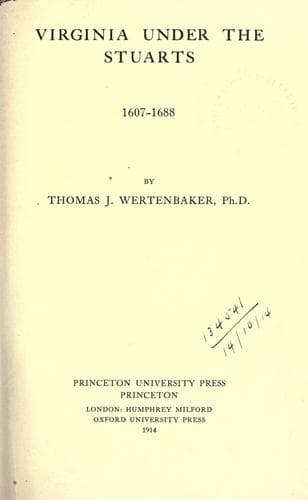
Virginia under the Stuarts 1607-1688Wertenbaker, Thomas Jefferson
History
Virginia under the Stuarts 1607-1688
Wertenbaker, Thomas Jefferson
Virginia -- History -- Colonial period, ca. 1600-1775
But there was another faction in Virginia, composed largely of small
planters and freedmen, which sympathized with the aims of their fellow
commons of the mother country. Prominent among these must have been a
small number of Virginia Puritans, who had for some years been subjected
to mild persecution. The overwhelming sentiment of the colony had long
been for strict uniformity in the Church "as neere as may be to the
canons in England", and several statutes had been passed by the Assembly
to suppress the Quakers and Puritans.[342] In 1642, Richard Bennett and
others of strong Calvinistic leanings, sent letters to Boston requesting
that Puritan ministers be sent to Virginia, to minister to their
non-conformist congregations.[343] The New Englanders responded readily,
despatching to their southern friends three ministers of
distinction--William Thompson, John Knowles and Thomas James. Despite
the laws against non-conformity these men anticipated little
interference with their work and even brought letters of introduction
from Governor Winthrop to Sir William Berkeley.[344] Little did they
know the temper of the new Virginia Governor. So far from welcoming this
Puritan invasion Berkeley determined to meet it with measures of stern
repression. A bill was put through the Assembly requiring all ministers
within the colony to conform to the "orders and constitutions of the
church of England", both in public and in private worship, and directing
the Governor and Council to expel all dissenters from the country.[345]
Disheartened at this unfriendly reception, James and Knowles soon
returned to New England, leaving Thompson to carry on the work. This
minister, in defiance of the law, lingered long in Virginia, preaching
often and making many converts.
Among those that embraced the Calvinistic tenets at this time was Thomas
Harrison, formerly Berkeley's chaplain. Harrison seems to have regarded
the massacre of 1644 as a judgment of God upon the colonists for their
persecution of the Puritans. His desertion of the established Church
aroused both the anger and the alarm of the Governor and in 1648 he was
expelled from his parish for refusing to use the Book of Common Prayer.
Later he left the colony for New England.
This persecution, although not severe enough to stamp out dissent in
Virginia, could but arouse among the Puritans a profound dissatisfaction
with the existing government, and a desire to coöperate with their
brethren of England in the great contest with the King. Although not
strong enough to raise the Parliamentary standard in the colony and to
seek religious freedom at the sword's point, the Puritans formed a
strong nucleus for a party of opposition to the King and his Governor.
Public-domain text, read in full here on John Shaqi.
Reviews
Reviews
No reviews yet
Be the first to share your thoughts on this work.
Elsewhere in the archive
Join the Discussion
Join the discussion
Sign in to leave a comment or review.
Sign InorCreate an account