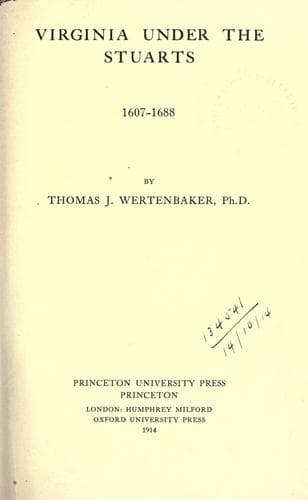
Virginia under the Stuarts 1607-1688Wertenbaker, Thomas Jefferson
History
Virginia under the Stuarts 1607-1688
Wertenbaker, Thomas Jefferson
Virginia -- History -- Colonial period, ca. 1600-1775
Moreover, in addition to the comparatively small class of Puritans,
there must have been in the colony hundreds of men, loyal to the
established church, who yet desired a more liberal government both in
England and in Virginia. A strong middle class was developing which must
have looked with sympathy upon the cause of the English Commons and with
jealousy upon the power of the Virginia Governor and his Council. There
is positive evidence that many poor men had been coming to Virginia from
very early times, paying their own passage and establishing themselves
as peasant proprietors. Wills still preserved show the existence at this
period of many little farms of five or six hundred acres, scattered
among the great plantations of the wealthy. They were tilled, not by
servants or by slaves, but by the freemen that owned them. Depending for
food upon their own cattle, hogs, corn, fruit and vegetables, and for
the other necessities of life upon their little tobacco crops, the poor
farmers of Virginia were developing into intelligent and useful
citizens. They constituted the backbone of a distinct and powerful
middle class, which even at this early period, had to be reckoned with
by aristocracy and Governor and King.
This section of the population was constantly being recruited from the
ranks of the indentured servants. The plantations of the rich were
tilled chiefly by bonded laborers, brought from the mother country. So
long as land was plentiful in Virginia the chief need of the wealthy was
for labor. Wage earners could not supply this need, for the poor man
would not till the fields of others when he could have land of his own
almost for the asking. So the planters surmounted this difficulty by
bringing workmen to the colony under indenture, to work upon their farms
for a certain number of years. Many a poor Englishman, finding the
struggle for existence too severe at home, thus surrendered for a while
his liberty, that in the end he might acquire a share in the good things
of the New World. After serving his master five or six years the servant
usually was given his liberty and with it fifty acres of land and a few
farm implements. Thus equipped, he could, with industry and frugality,
acquire property and render himself a useful citizen in his adopted
country. There can be no doubt that many hundreds of former servants,
become prosperous, did unite with the free immigrants of humble means to
form a vigorous middle class.
Nothing could be more natural than that the small farmers should regard
Parliament as the champion of the poor Englishman at home and in the
colony. They knew full well that if Charles should triumph over the
Commons, his victory would mean greater power for their Governor,
greater privilege for the wealthy planters. On the other hand, the
King's defeat might bring increased influence to the middle class and to
the Burgesses.
Public-domain text, read in full here on John Shaqi.
Reviews
Reviews
No reviews yet
Be the first to share your thoughts on this work.
Elsewhere in the archive
Join the Discussion
Join the discussion
Sign in to leave a comment or review.
Sign InorCreate an account