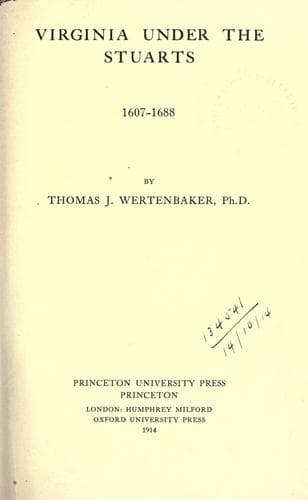
Virginia under the Stuarts 1607-1688Wertenbaker, Thomas Jefferson
History
Virginia under the Stuarts 1607-1688
Wertenbaker, Thomas Jefferson
Virginia -- History -- Colonial period, ca. 1600-1775
Even before the news of these events reached England, Sir William had
aroused the anger of Parliament by his persecution of the Puritans. Some
of the people of Nansemond county had written, complaining of the
banishment of Mr. Harrison, whom they described as an able minister and
a man of splendid character. The English Council wrote Berkeley
commanding him to restore Mr. Harrison to his parish. "Wee know," they
said, "you cannot be ignorant that the use of the common prayer book is
prohibited by the parliament of England."[349] And when they learned
that the colony had refused to acknowledge the Commonwealth, and still
adhered to the House of Stuart, they were determined to punish the
Virginians for their temerity. Since it would be exceedingly
inconvenient at this time of uncertainty and change to send an
expedition across the Atlantic, it was decided to bring the colonists to
their senses by cutting off their foreign trade. An act was passed by
Parliament in October, 1650, declaring that since the colony had been
settled by the English at great cost to the nation, it should rightly be
under the authority of the present government; that divers persons in
Virginia had committed open treason, "traytorously by force and
Subtilty" usurping the government and defying the Commonwealth; and in
order to repress speedily the rebellious colonists and to inflict upon
them a merited punishment, they were to be forbidden all "Commerce or
Traffique with any people Whatsoever". The full force of the English
navy was to be used in carrying out this act, and all commanders were
directed to seize and bring in foreign vessels found trading with the
colony. No English ships were to sail for Virginia without special
license from the Council of State.[350]
This was a dire threat indeed. To cut off all commerce with England and
foreign countries would bring utter ruin upon the planters, for their
tobacco crop would then be without a market. Even now, however, the
Governor did not falter in his loyalty. He felt, no doubt, that
Parliament would have difficulty in enforcing this act, and he looked to
the Dutch merchantmen to take off the tobacco.
Public-domain text, read in full here on John Shaqi.
Reviews
Reviews
No reviews yet
Be the first to share your thoughts on this work.
Elsewhere in the archive
Join the Discussion
Join the discussion
Sign in to leave a comment or review.
Sign InorCreate an account