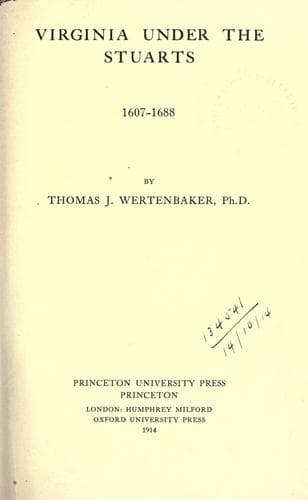
Virginia under the Stuarts 1607-1688Wertenbaker, Thomas Jefferson
History
Virginia under the Stuarts 1607-1688
Wertenbaker, Thomas Jefferson
Virginia -- History -- Colonial period, ca. 1600-1775
It is not possible to determine how numerous was the Parliamentary party
in Virginia, but the faction was powerful enough to cause serious
apprehension to the loyalists. So bitter was the feeling that fears of
assassination were entertained for Sir William Berkeley, and a guard of
ten men was granted him. We are "sensible", declared the Assembly, in
1648, "of the many disaffections to the government from a schismaticall
party, of whose intentions our native country of England hath had and
yet hath too sad experience".[346]
But the commons of Virginia were not prepared to raise the standard of
revolt. They must have lacked organization and leaders. Most of the
aristocracy and wealth of Virginia was arrayed against them, while the
government was in the hands of a man noted for his passionate attachment
to the Throne. The Parliamentary party must have felt it best to await
the event of the struggle in England, pinning their hopes upon the
success of their comrades there. But even after Parliament had won the
victory, after the King had been executed, they were not strong enough
to overthrow Berkeley's government and force Virginia into obedience to
the Commonwealth.
The news of the death of Charles I filled the royalists of Virginia with
grief and anger. It seemed to them that the cause of law and order and
religion in the unhappy kingdom had fallen with their monarch. Moreover,
they could but expect the victorious party, after settling all at home,
to extend their arms to the little colony and force upon them a
reluctant obedience to the new government. But the intrepid Berkeley was
determined never to submit until compelled to do so by force of arms.
Charles II was proclaimed King. The Assembly was called together and a
law enacted declaring it high treason to question, even by insinuation,
the "undoubted & inherent right of his Majesty ... to the Collony of
Virginia, and all other his majesties dominions".[347] The Assembly
referred to Charles I in terms of reverence and affection, as their late
blessed and sainted King, and, unmindful of consequences, denounced his
executioners as lawless tyrants. For any person to cast dishonor or
censure upon the fallen monarch, or to uphold in any way the proceedings
against him, or to assert the legality of his dethronement, was declared
by the Assembly high treason. "And it is also enacted," they continued,
"that what person soever, by false reports and malicious rumors shall
spread abroad, among the people, any thing tending to change of
government, ... such persons, not only the authors of ... but the
reporters and divulgers thereof, shall be adjudged guilty."[348]
Public-domain text, read in full here on John Shaqi.
Reviews
Reviews
No reviews yet
Be the first to share your thoughts on this work.
Elsewhere in the archive
Join the Discussion
Join the discussion
Sign in to leave a comment or review.
Sign InorCreate an account