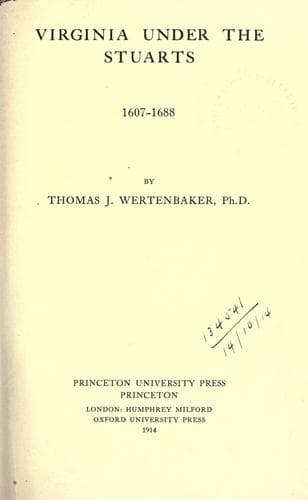
Virginia under the Stuarts 1607-1688Wertenbaker, Thomas Jefferson
History
Virginia under the Stuarts 1607-1688
Wertenbaker, Thomas Jefferson
Virginia -- History -- Colonial period, ca. 1600-1775
Fortunately, however, the threatened conflict was averted by the
persuasion of the Parliamentary commissioners. These men, anxious to
avoid civil war, availed themselves of the authority given them by the
Council of State, to offer very lenient terms of surrender. Some of them
seem to have preceded the fleet to Virginia, to consult with their
friends and to formulate plans to render the Governor's resistance
ineffectual. It is not improbable that these efforts were seconded by
some of the most prominent men of the colony. Two members of the Council
itself, it is said, who possessed goods of great value upon vessels in
the fleet, received warning that their property would be at once
confiscated, if they gave their support to the Governor. They therefore
were constrained to advocate submission. With division in the ranks of
the colonists and with the invaders ready for action, even Berkeley was
at last forced to give way and consent to a capitulation.
The terms of surrender were drawn up at Jamestown and agreed to by the
commissioners on the one hand, and by the Governor, Council and
Burgesses on the other. It was agreed first, that Virginia should
acknowledge its due allegiance to the Commonwealth of England, and "to
the lawes there established". This submission, it was declared, was "a
voluntary act, not forced nor constrained by a conquest upon the
country".[353] It was also stipulated "that the people of Virginia have
free trade as the people of England do enjoy to all places and with all
nations according to the lawes of that commonwealth". Even more
interesting was the agreement "that Virginia shall be free from all
taxes, customs and impositions whatsoever, and none to be imposed on
them without consent of the Grand Assembly, and soe that neither fforts
nor castles bee erected or garrisons maintained without their consent".
When these terms of surrender were reported to the English government,
Parliament thought that the commissioners had been too liberal in their
concessions, and some of the articles were not ratified.
The commissioners granted full pardon and indemnity for all "acts, words
or writeings done or spoken against the parliament" and any persons
refusing to take the oath of allegiance to the new government were given
"a yeares time ... to remove themselves and their estates out of
Virginia". The use of the Book of Common Prayer was permitted for one
year in the parishes that so desired, and no ministers were deprived of
their charges or their livings.[354]
Separate articles were drawn up between the commissioners and the
Governor and Council. Neither Berkeley nor the Councillors were to be
compelled, during the ensuing twelve months, to take the oath of
allegiance. They were not to be censured for speaking well in private of
the King. They were given leave to sell all their property and to quit
the country without molestation. They were permitted to send a message
to Charles II, giving an account of the surrender.[355]
Public-domain text, read in full here on John Shaqi.
Reviews
Reviews
No reviews yet
Be the first to share your thoughts on this work.
Elsewhere in the archive
Join the Discussion
Join the discussion
Sign in to leave a comment or review.
Sign InorCreate an account