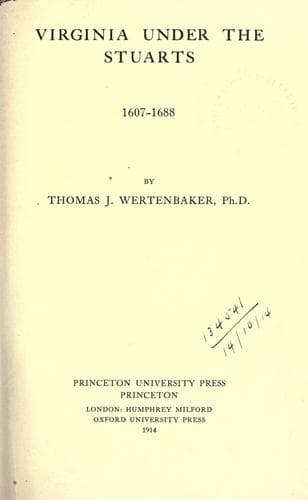
Virginia under the Stuarts 1607-1688Wertenbaker, Thomas Jefferson
History
Virginia under the Stuarts 1607-1688
Wertenbaker, Thomas Jefferson
Virginia -- History -- Colonial period, ca. 1600-1775
The commissioners were now confronted with the all-important task of
establishing a new government. They had been given power by the Council
of State to hold an election of Burgesses granting the franchise to all
who had taken the oath of allegiance. Feeling, doubtless, a reluctance
to assume the entire responsibility of moulding a new constitution, they
resolved to wait until the Burgesses assembled and to consult with them
in all their measures. The election was held without delay, and the
members were sworn in on April 26th, 1652.
The Burgesses and the commissioners then entered upon a long and serious
debate concerning "the settling and governing of Virginia".[356] The
English Council had not, it would seem, given specific directions in
regard to this work, so the members of the little constitutional
convention were practically at liberty to do what they chose. Realizing,
however, that all might be changed if it proved unsatisfactory to
Parliament, they proceeded cautiously. Their chief concern was to
establish a tentative government that would prevent present confusion
and could later be perfected by the Council of State. It so happened,
however, that the English, amid the confusion of the times, neglected to
attend to this matter, and the work of the convention remained
essentially unaltered throughout the Commonwealth period.
The House of Burgesses, since it had been officially recognized by the
Council of State, was made the chief governing body of the colony.
Except for the veto of the English government its power was to be
unlimited. It was to elect the Governor and to specify his duties. If
his administration proved unsatisfactory it might remove him from
office. The Burgesses were also to elect the Council, to prescribe its
functions and limit its power. This proud body, which had formerly been
so powerful, was now to exist only on the suffrage of the House. It was
even debated whether Councillors should be admitted to membership in the
General Assembly. The appointment of all officials was also to
"appertain to the Burgesses, the representatives of the people", but it
was agreed that for the present most of the first nominations should be
left to the Governor and the commissioners.[357]
Public-domain text, read in full here on John Shaqi.
Reviews
Reviews
No reviews yet
Be the first to share your thoughts on this work.
Elsewhere in the archive
Join the Discussion
Join the discussion
Sign in to leave a comment or review.
Sign InorCreate an account