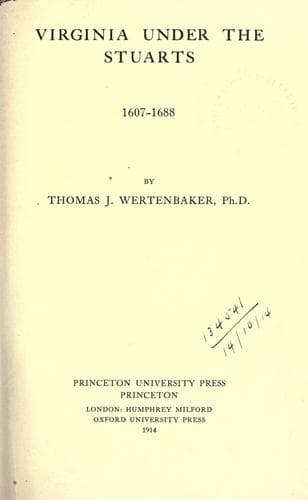
Virginia under the Stuarts 1607-1688Wertenbaker, Thomas Jefferson
History
Virginia under the Stuarts 1607-1688
Wertenbaker, Thomas Jefferson
Virginia -- History -- Colonial period, ca. 1600-1775
Thus early in the history of the colony was enunciated the principle
that taxation without representation is unjust and illegal. The men of
Northampton do not speak of the doctrine as something new, but as a
thing understood and recognized. Certain it is that the people of
Virginia, in all periods of their colonial history, realized the vast
importance of confining the power of taxation to their own Assembly.
But the leaders of the new government did not receive the petition with
favor. They were willing to give Northampton her due quota of Burgesses,
but they were angered at the suggestion of separation. Moreover, the
disorders on the Eastern Shore became more pronounced and the justices
were compelled to seek aid from the Council in protecting the Dutch. In
June, 1653, the turbulent people met and, amid scenes of disorder,
denounced the action of the authorities. When a voice from the crowd
cried out that the justices were a "company of asses and villyanes", the
people roared out their approval. The Assembly, at its meeting in June,
1653, was forced to take active steps to suppress the agitation and to
restore order upon the peninsula. Mr. Bennett with several members of
the Assembly, was sent to Northampton, "for the settlement of the peace
of that countie, and punishinge delinquents". In this he seems to have
been entirely successful, for we hear no more of disorders upon the
Eastern Shore during this period.[361]
When the commissioners and the Burgesses, in 1652, established anew the
gubernatorial office, they were somewhat vague in defining the duties
belonging to it. They first declared that Mr. Bennett was to exercise
"all the just powers and authorities that may belong to that place
lawfully".[362] But that it was not their intention to give the new
officer the prerogatives enjoyed by the royal Governor is shown by their
further statement that he was to have such power only as should be
granted him from time to time by the Assembly.[363] This lack of
clearness led, quite naturally, to several clashes between the
legislative and executive branches of the government.
At the session of Assembly of July, 1653, the Burgesses showed that they
would brook no interference from the Governor with their affairs. On the
eve of the election of the Speaker, they received a message from Mr.
Bennett and the Council advising them not to choose a certain
Lieutenant-Colonel Chiles. Although it was clearly shown that this
gentleman could not serve with propriety, the Burgesses gave him the
election, merely, it would seem, as a rebuke to the presumption of the
Governor.[364]
Public-domain text, read in full here on John Shaqi.
Reviews
Reviews
No reviews yet
Be the first to share your thoughts on this work.
Elsewhere in the archive
Join the Discussion
Join the discussion
Sign in to leave a comment or review.
Sign InorCreate an account